Advertisements
Advertisements
प्रश्न
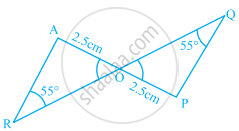
In the following figure, ∆ARO ≅ ∆ ______.
Advertisements
उत्तर
In the following figure, ∆ARO ≅ ∆PQO.
Explanation:
In ∆ARO and ∆PQO,
∠ARO = ∠PQO = 55°
∠AOR = ∠POQ ...[Vertically opposite angles]
∴ ∠RAO = ∠QPO ...[∵ If two angles of a triangle are equal to two angles of another triangle then the third angle is also equal]
AO = PO = 2.5 cm
∴ ∆ARO ≅ ∆PQO ...[ASA criterion]
APPEARS IN
संबंधित प्रश्न
Given below are measurements of some parts of two triangles. Examine whether the two triangles are congruent or not, by the ASA congruence rule. In the case of congruence, write it in symbolic form.
∆DEF, ∠D = 60º, ∠F = 80º, DF = 6 cm.
∆PQR, ∠Q = 60º, ∠R = 80º, QP = 6 cm.
To conclude the congruency of triangles, mark the required information in the following figure with reference to the given congruency criterion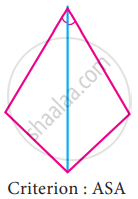
For the given pair of triangles state the criterion that can be used to determine the congruency?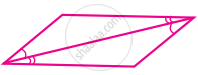
In the following figure, Δ ______ ≅ ΔPQR.
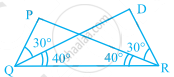
If hypotenuse and an acute angle of one right triangle are equal to the hypotenuse and an acute angle of another right triangle, then the triangles are congruent.
In the following figure, AD ⊥ BC and AD is the bisector of angle BAC. Then, ∆ABD ≅ ∆ACD by RHS.

In the given pairs of triangles of figure, applying only ASA congruence criterion, determine which triangles are congruent. Also, write the congruent triangles in symbolic form.

In the given pairs of triangles of figure, applying only ASA congruence criterion, determine which triangles are congruent. Also, write the congruent triangles in symbolic form.
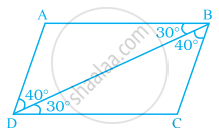
In the given pairs of triangles of figure, applying only ASA congruence criterion, determine which triangles are congruent. Also, write the congruent triangles in symbolic form.
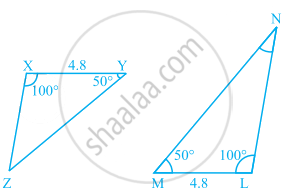
In the given pairs of triangles of figure, applying only ASA congruence criterion, determine which triangles are congruent. Also, write the congruent triangles in symbolic form.