Advertisements
Advertisements
प्रश्न
In the figure of a cube, Which edge is the intersection of faces EFGH and EFBA?

Advertisements
उत्तर
From the given figure, we can observe that EF is the intersection of faces EFGH and EFBA.
APPEARS IN
संबंधित प्रश्न
Draw the top, front and side view of the following solid shapes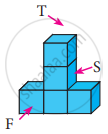
Buddha wants to make a paper cube using a squared sheet. He knows that all the faces of a cube are squares. He draws two different Shapes.
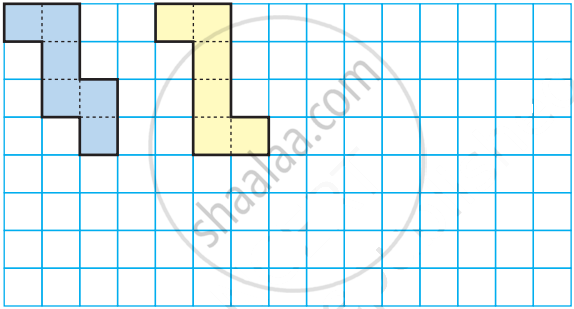
- Look around and discuss which things around you look like a cube. List a few.
The net shown below can be folded into the shape of a cube. The face marked with the letter L is opposite to the face marked with which letter?

Count the number of cubes in the given shape.
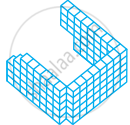
Complete the table given below by putting tick mark across the respective property found in the solids mentioned.
| Solids | ||||
| Properties | Cone | Cylinder | Prism | Pyramid |
| 1. The figure is a Polyhedron. | ||||
| 2. The figure has diagonals. | ||||
| 3. The shape has curved edges. | ||||
| 4. The base of figure is a polygon. | ||||
| 5. The bases are congruent. | ||||
| 6. The base of figure is a polygon and other faces meet at a single point. | ||||
| 7. The base of figure is a curved edge and other faces meet at a single point. | ||||
Out of ______ faces of a square pyramid, ______ are triangles and ______ is/are squares.
Cuboid is a rectangular ______.
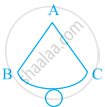 is a net of a ______ . `→` Circumference of circle = ______.
If the base of a pyramid is a square, it is called a square pyramid.
Draw the net of triangular pyramid with base as equilateral triangle of side 3 cm and slant edges 5 cm.
