Advertisements
Advertisements
प्रश्न
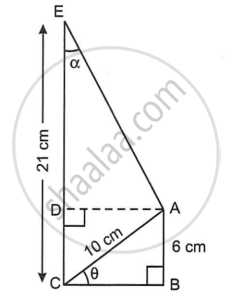
In the figure given alongside, AB = 6 cm, AC = 10 cm, ∠B = 90° and EC = 21 cm.
Find:
- AD and AE
- cos θ + sin θ
- cot α + cosec α.
योग
Advertisements
उत्तर
Given: △ABC is a right-angled triangle with AB = 6 cm, AC = 10 cm, ∠B = 90° and EC = 21 cm.
Step 1: Find BC using the Pythagorean theorem in △ABC.
AC2 = AB2 + BC2 ...[Using the Pythagorean theorem]
102 = 62 + BC2
100 = 36 + BC2
BC2 = 100 − 36
BC2 = 64
BC = `sqrt64`
BC = 8 cm
Step 2:
(i) Find AD
(i) Find AD
since ADCB forms a rectangle (implied by the right angles at B and D, and AD || BC), AD = BC.
Therefore, AD = 8
Finding DE
DE = EC − DC
= 21 − 6
= 15
Find AE using the Pythagorean theorem in △ADE
△ADE is a right-angled triangle with ∠D = 90°
AE2 = AD2 + DE2
AE2 = 82 +152
AE2 = 64 + 225 = 289
AE = `sqrt289` = 17 CM
AE = 17 cm`
Step 3:
(ii) Find cos θ + sinθ
In △ABC, cos θ = `"adjacent"/"hypotenuse" = (BC)/(AC) = 8/10 = 4/5`
Find sin θ in △ABC
In △ABC, sin θ = `"opposite"/"hypotenuse" = (AB)/(AC) = 6/10 = 3/5`
cos θ + sin θ = `4/5 + 3/5 = 7/5` ... [Calculating cos θ + sin θ]
cos θ + sin θ = `7/5` or 1.4
(iii) Find cot α + cosec α.
In △ADE, cot α = `"adjacent"/"opposite" = (DE)/(AD) = (15)/8` ...[cot α in △ADE]
In △ADE, cosec α = `"hypotenuse"/"opposit" = (AE)/(AD)` ... [Finding cosec α in △ADE]
= `17/8`
= cot α + cosec α ... [calculating cot α + cosec α]
= `15/8 + 17/8`
= `32/8`
= 4
cot α + cosec α = 4
shaalaa.com
क्या इस प्रश्न या उत्तर में कोई त्रुटि है?
