Advertisements
Advertisements
प्रश्न
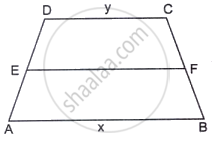
In the adjoining figure, a trapezium ABCD is shown in which AB || DC, AB = x and DC = y. If E and F are the mid-points of the sides AD and BC respectively, then ar (ABFE) : ar (EFCD) is:
विकल्प
x : y
(3x + y) : (x + 3y)
(x + 3y) : (3x + y)
(2x + y) : (3x + y)
MCQ
Advertisements
उत्तर
(3x + y) : (x + 3y)
Explanation:
Let the trapezium height be h.
The segment EF joining mid‑points of AD and BC is parallel to the bases and has length `(x + y)/2` and it lies midway so each smaller trapezoid has height `h/2`.
`"Area" (ABFE) = 1/2 xx (AB + EF) xx (h/2)`
= `1/2 xx (x + (x + y)/2) xx (h/2)`
= `((3x + y)h)/8`
`"Area" (EFCD) = 1/2 xx (EF + DC) xx (h/2)`
= `((x + 3y)h)/8`
Thus, ar (ABFE) : ar (EFCD) = (3x + y) : (x + 3y).
shaalaa.com
क्या इस प्रश्न या उत्तर में कोई त्रुटि है?
