हिंदी

In Parallelogram Abcd, P is Mid-point of Ab. Cp and Bd Intersect Each Other at Point O. If Area Of Pob = 40 Cm2, and Op: Oc = 1:2, Find: Areas Of Boc And Pbc Areas Of Abc and Parallelogram Abcd - Mathematics

Advertisements
Advertisements

प्रश्न

In parallelogram ABCD, P is the mid-point of AB. CP and BD intersect each other at point O. If the area of ΔPOB = 40 cm2, and OP: OC = 1:2, find:
(i) Areas of ΔBOC and ΔPBC
(ii) Areas of ΔABC and parallelogram ABCD.

योग
Advertisements

उत्तर

(i) Joining AC we have the following figure
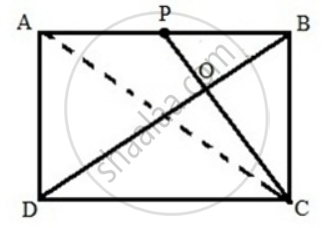
Consider the triangles ΔPOB and ΔCOD
∠POB = ∠DOC             ...[ vertically opposite angles ]
∠OPB = ∠ODC             ...[ AB and DC are parallel, CP and BD are the transversals, alternate interior angles are equal ]

Therefore, by Angle-Angle similarly criterion of congruence, ΔPOB ∼ ΔCOD
Since P is the mid-point AP = BP, and AB = CD, we have CD = 2 BP
Therefore, We have,

`"BP"/"CD" = "OP"/"OC"= "OB"/"OD" = 1/2`

⇒ OP : OC = 1: 2

(ii) Since from part ( i ), we have

`"BP"/"CD" = "OP"/"OC"= "OB"/"OD" = 1/2` ,

The ratio between the areas of two similar triangles is equal to the ratio between the square of the corresponding sides.
Here, ΔDOC and ΔPOB are similar triangles.
Thus, we have , 

`" Ar.( ΔDOC)"/"Ar.( ΔPOB )" ="DC"^2/"PB"^2"`

⇒ `"Ar.(ΔDOC )"/"Ar.( ΔPOB )" ="(2PB)"^2/"PB"^2"`

⇒ `"Ar.( ΔDOC )"/"Ar.( ΔPOB )" ="4PB"^2/"PB"^2"`

⇒ `"Ar.( ΔDOC )"/"Ar.( ΔPOB )"` = 4

⇒  Ar.( ΔDOC ) = 4Ar, ( ΔPOB )
                      =  4 x 40 
                      = 160 cm 

Now consider Ar. ( ΔDBC ) = Ar. ( ΔDOC ) + Ar. (Δ BOC )
                                        = 160 + 80
                                       = 160 cm2  

Two triangles are equal in the area if they are on equal bases and between the same parallels.

Therefore, Ar. ( ΔDBC ) = Ar. ( ΔABC ) = 240 cm
The median divides the triangles into areas of two equal triangles.
Thus, CP is the median of the triangle ABC.
Hence, Ar. ( ΔABC ) = 2 Ar. ( ΔPBC )
Ar. ( ΔPBC ) = `"Ar.( ΔABC  )"/2`
Ar. ( ΔPBC ) = 120 cm

( iii ) From part (ii) we have,
Ar. ( ΔABC ) = 2Ar. ( PBC ) = 240 cm
The area of a triangle is half the area of the parallelogram if both are on equal bases and between the same parallels.

Thus, Ar. ( ΔABC ) = `1/2` Ar. [ || gm ABCD ]

AR. [ || gm ABCD ] = 2 Ar. ( ΔABC )
AR. [ || gm ABCD ] = 2 x 240
AR. [ || gm ABCD ] = 480 cm

shaalaa.com
Figures Between the Same Parallels
  क्या इस प्रश्न या उत्तर में कोई त्रुटि है?
अध्याय 16: Area Theorems [Proof and Use] - Exercise 16 (C) [पृष्ठ २०२]

APPEARS IN

सेलिना Concise Mathematics [English] Class 9 ICSE
अध्याय 16 Area Theorems [Proof and Use]
Exercise 16 (C) | Q 4 | पृष्ठ २०२

संबंधित प्रश्न

The given figure shows a rectangle ABDC and a parallelogram ABEF; drawn on opposite sides of AB.
Prove that: 
(i) Quadrilateral CDEF is a parallelogram;
(ii) Area of the quad. CDEF
= Area of rect. ABDC + Area of // gm. ABEF.


In the following, AC // PS // QR and PQ // DB // SR.

Prove that: Area of quadrilateral PQRS = 2 x Area of the quad. ABCD.


In the given figure, M and N are the mid-points of the sides DC and AB respectively of the parallelogram ABCD.

If the area of parallelogram ABCD is 48 cm2;
(i) State the area of the triangle BEC.
(ii) Name the parallelogram which is equal in area to the triangle BEC.


ABCD is a parallelogram a line through A cuts DC at point P and BC produced at Q. Prove that triangle BCP is equal in area to triangle DPQ.


ABCD is a parallelogram in which BC is produced to E such that CE = BC and AE intersects CD at F.

If ar.(∆DFB) = 30 cm2; find the area of parallelogram.


In a parallelogram ABCD, point P lies in DC such that DP: PC = 3:2. If the area of ΔDPB = 30 sq. cm.
find the area of the parallelogram ABCD.


ABCD is a parallelogram. P and Q are the mid-points of sides AB and AD respectively.
Prove that area of triangle APQ = `1/8` of the area of parallelogram ABCD.


ABCD is a trapezium with AB parallel to DC. A line parallel to AC intersects AB at X and BC at Y.
Prove that the area of ∆ADX = area of ∆ACY.


E, F, G, and H are the midpoints of the sides of a parallelogram ABCD.
Show that the area of quadrilateral EFGH is half of the area of parallelogram ABCD.


In ΔABC, E and F are mid-points of sides AB and AC respectively. If BF and CE intersect each other at point O,
prove that the ΔOBC and quadrilateral AEOF are equal in area.


Share
Notifications

Englishहिंदीमराठी


      Forgot password?
Use app×