Advertisements
Advertisements
प्रश्न
In parallelogram ABCD, A = (6, 0), B = (12, −4) and C = (4, −4); then the cоordinates of vertex D are ______.
विकल्प
(2, 0)
(−2, 0)
(0, 2)
(0, −2)
Advertisements
उत्तर
In parallelogram ABCD, A = (6, 0), B = (12, −4) and C = (4, −4); then the cоordinates of vertex D are (−2, 0).
Explanation:
Let co-ordinates of vertex D be (x, y).
We know that,
Diagonal of parallelogram bisect each other.
From figure,
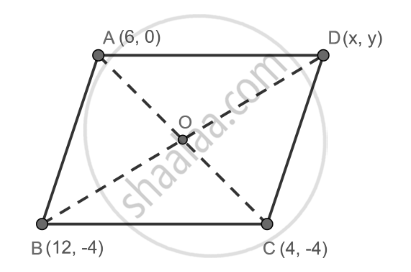
O (a, b) is the mid-point of AC.
By mid-point formula,
Mid-point = `((x_1+x_2)/2, (y_1+y_2)/2)`
Substituting values we get :
(a, b) = `((6 + 4)/2, (0 + (-4))/2)`
= `(10/2, (-4)/2)`
= (5, −2).
From figure,
O is also the mid-point of BD.
∴ (5, −2) = `((12 + x)/2, (-4 + y)/2)`
⇒ `(12 + x)/2 = 5 and (−4+y)/2 = −2`
⇒ 12 + x = 10 and −4 + y = −4
⇒ x = 10 − 12 and y = −4 + 4
⇒ x = −2 and y = 0
D = (−2, 0)
