Advertisements
Advertisements
प्रश्न
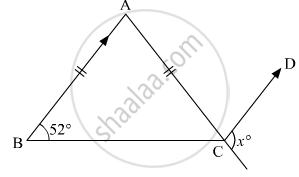
In the given figure, ABC is an isosceles triangle whose side AC is produced to E. Through C, CD is drawn parallel to BA. The value of x is
विकल्प
52°
76°
156°
104°
Advertisements
उत्तर
We are given that;
ΔABC , is isosceles
AB = AC
∠B = ∠C
∠C = 52
And AB || CD
We are asked to find angle x
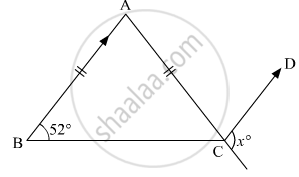
From the figure we have
∠ACB = 52°
Therefore,
∠A = `180° - 2 xx 52° `
= 76°
Since AB || DC , so
∠ACD = ∠BAC
= 76°
Now
x + 76 = 180
= 180 - 76
= 104
APPEARS IN
संबंधित प्रश्न
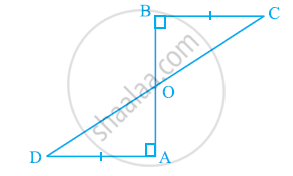
AD and BC are equal perpendiculars to a line segment AB (See the given figure). Show that CD bisects AB.
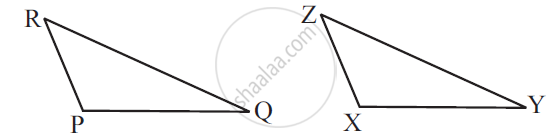
Which congruence criterion do you use in the following?
Given: ZX = RP
RQ = ZY
∠PRQ = ∠XZY
So, ΔPQR ≅ ΔXYZ
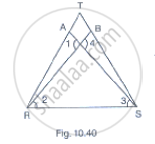
In Fig. 10.40, it is given that RT = TS, ∠1 = 2∠2 and ∠4 = 2∠3. Prove that ΔRBT ≅ ΔSAT.
Which of the following statements are true (T) and which are false (F):
Two right triangles are congruent if hypotenuse and a side of one triangle are respectively equal equal to the hypotenuse and a side of the other triangle.
The perpendicular bisectors of the sides of a triangle ABC meet at I.
Prove that: IA = IB = IC.
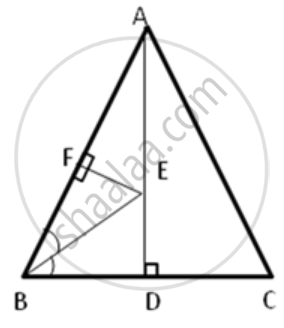
In the following figure, AB = AC and AD is perpendicular to BC. BE bisects angle B and EF is perpendicular to AB.
Prove that : ED = EF
In a ΔABC, BD is the median to the side AC, BD is produced to E such that BD = DE.
Prove that: AE is parallel to BC.
In the following diagram, AP and BQ are equal and parallel to each other. 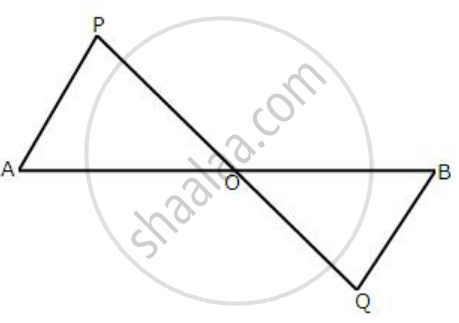
Prove that: AB and PQ bisect each other.
In quadrilateral ABCD, AD = BC and BD = CA.
Prove that:
(i) ∠ADB = ∠BCA
(ii) ∠DAB = ∠CBA
ABC is an isosceles triangle with AB = AC and BD and CE are its two medians. Show that BD = CE.
