Advertisements
Advertisements
प्रश्न
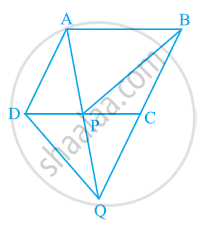
In the following figure, ABCD is parallelogram and BC is produced to a point Q such that AD = CQ. If AQ intersect DC at P, show that
ar (BPC) = ar (DPQ).
[Hint: Join AC.]
Advertisements
उत्तर
It is given that ABCD is a parallelogram.
AD || BC and AB || DC(Opposite sides of a parallelogram are parallel to each other)
Join point A to point C.
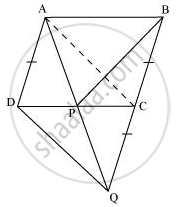
Consider ΔAPC and ΔBPC
ΔAPC and ΔBPC are lying on the same base PC and between the same parallels PC and AB. Therefore,
Area (ΔAPC) = Area (ΔBPC) ... (1)
In quadrilateral ACDQ, it is given that
AD = CQ
Since ABCD is a parallelogram,
AD || BC (Opposite sides of a parallelogram are parallel)
CQ is a line segment which is obtained when line segment BC is produced.
∴ AD || CQ
We have,
AC = DQ and AC || DQ
Hence, ACQD is a parallelogram.
Consider ΔDCQ and ΔACQ
These are on the same base CQ and between the same parallels CQ and AD. Therefore,
Area (ΔDCQ) = Area (ΔACQ)
⇒ Area (ΔDCQ) − Area (ΔPQC) = Area (ΔACQ) − Area (ΔPQC)
⇒ Area (ΔDPQ) = Area (ΔAPC) ... (2)
From equations (1) and (2), we obtain
Area (ΔBPC) = Area (ΔDPQ)
संबंधित प्रश्न
A farmer was having a field in the form of a parallelogram PQRS. She took any point A on RS and joined it to points P and Q. In how many parts the field is divided? What are the shapes of these parts? The farmer wants to sow wheat and pulses in equal portions of the field separately. How should she do it?
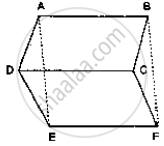
In the given below fig. ABCD, ABFE and CDEF are parallelograms. Prove that ar (ΔADE)
= ar (ΔBCF)
ABCD is a parallelogram, G is the point on AB such that AG = 2 GB, E is a point of DC
such that CE = 2DE and F is the point of BC such that BF = 2FC. Prove that:
(1) ar ( ADEG) = ar (GBCD)
(2) ar (ΔEGB) = `1/6` ar (ABCD)
(3) ar (ΔEFC) = `1/2` ar (ΔEBF)
(4) ar (ΔEBG) = ar (ΔEFC)
(5)ΔFind what portion of the area of parallelogram is the area of EFG.
PQRS is a rectangle inscribed in a quadrant of a circle of radius 13 cm. A is any point on PQ. If PS = 5 cm, then ar (PAS) = 30 cm2.
ABCD is a parallelogram in which BC is produced to E such that CE = BC (Figure). AE intersects CD at F. If ar (DFB) = 3 cm2, find the area of the parallelogram ABCD.
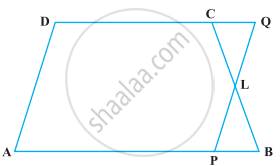
In trapezium ABCD, AB || DC and L is the mid-point of BC. Through L, a line PQ || AD has been drawn which meets AB in P and DC produced in Q (Figure). Prove that ar (ABCD) = ar (APQD)
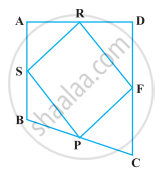
If the mid-points of the sides of a quadrilateral are joined in order, prove that the area of the parallelogram so formed will be half of the area of the given quadrilateral (Figure).
[Hint: Join BD and draw perpendicular from A on BD.]
The diagonals of a parallelogram ABCD intersect at a point O. Through O, a line is drawn to intersect AD at P and BC at Q. Show that PQ divides the parallelogram into two parts of equal area.
ABCD is a trapezium in which AB || DC, DC = 30 cm and AB = 50 cm. If X and Y are, respectively the mid-points of AD and BC, prove that ar (DCYX) = `7/9` ar (XYBA)
In the following figure, ABCD and AEFD are two parallelograms. Prove that ar (PEA) = ar (QFD). [Hint: Join PD].

