Advertisements
Advertisements
प्रश्न
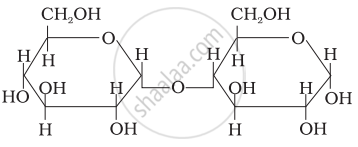
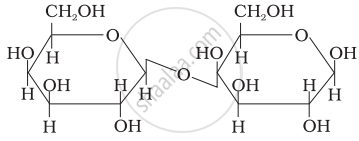
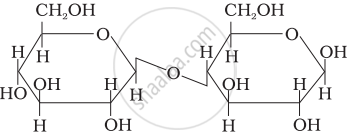
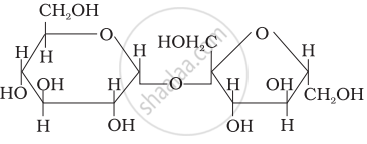
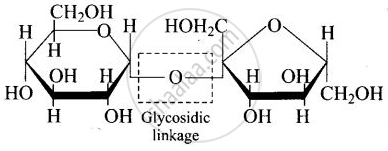
In disaccharides, if the reducing groups of monosaccharides i.e. aldehydic or ketonic groups are bonded, these are non-reducing sugars. Which of the following disaccharide is a non-reducing sugar?
विकल्प
Advertisements
उत्तर
Explanation:
This structure represents sucrose in which α-D glucose and β-D-fructose is attached to each other by C1 – C2 glycosidic linkage.
Since, reducing groups of glucose and fructose are involved in glycosidic bond formation, this is considered as non-reducing sugar.
APPEARS IN
संबंधित प्रश्न
What do you understand by the term glycosidic linkage?
Answer the following question.
Write the products obtained after the hydrolysis of lactose.
Which of the following is a disaccharide?
The sugar that is characteristic of milk is ____________.
Which one is a disaccharide?
The commonest disaccharide has the molecular formula:
Maltose and glucose are ____________.
Which of the following has not a glucosidic linkage?
Which one of the following statement is correct about sucrose?
Match the following enzyms given in Column I with the reactions they catalyse given in Column II.
| Column I (Enzymes) | Column II (Reactions) |
| (i) Invertase | (a) Decomposition of urea into NH3 and CO2 |
| (ii) Maltase | (b) Conversion of glucose into ethyl alcohol |
| (iii) Pepsin | (c) Hydrolysis of maltose into glucose |
| (iv) Urease | (d) Hydrolysis of cane sugar |
| (v) Zymase | (e) Hydrolysis of proteins into peptides |
Lactose on hydrolysis yields
Which disaccharide is present in milk?
Which of the following will not show mutarotation?
Hydrolysis of sucrose is called ______.
When sucrose is hydrolysed the optical rotation values are measured using a polarimeter and are given in the following table:
| S. No. | Time (hours) | Specific Rotation |
| 1 | 0 | + 66.5° |
| 2 | ∞ | - 39.9° |
- Account for the two specific rotation values.
- What is the specific name given to sucrose based on the above observation?
- One of the products formed during the hydrolysis of sucrose is a glucose, that reacts with hydroxylamine to give compound A. Identify compound A.
