Advertisements
Advertisements
प्रश्न
In the below fig., name the following:
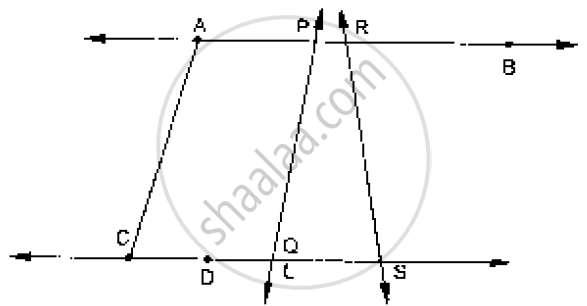
(i) five line segments.
(ii) Five rays.
(iii) Four collinear points.
(iv) Two pairs of non-intersecting line segments.
Advertisements
उत्तर
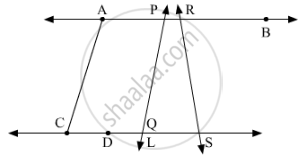
(i) A line segment is a part of line defined by two end points. So in the given figure 7.17, five line segments are:
(1) AC
(2) CD
(3) AP
(4) PQ
(5) RS
(ii) A ray is the part of line with one end point and one end which can be extended. So in the given figure 7.17, five rays are:
(1) Ray RB
(2) Ray RS
(3) Ray PQ
(4) Ray DS
(5) Ray AB
(iii) Collinear points are the points which are present on the same line. In the present figure 7.17, there are two sets of four collinear points.
(1) A, P, R, B
(2) C, D, Q, S
(iv) In the given figure 7.17, two pairs of non intersecting line segments are:
(1) AB and CS
(2) AC and PQ
APPEARS IN
संबंधित प्रश्न
Define the following terms :
Parallel lines
Define the following term
Concurrent lines
Define the following term
Ray
Given two points P and Q, find how many line segments do they deter-mine.
Name the line segments determined by the three collinear points P, Q and R.
Write the truth value (T/F) of each of the following statements
Every ray has a finite length.
Write the truth value (T/F) of each of the following statement:
A segment has one end-point only.
Write the truth value (T/F) of each of the following statement:
Only a single line may pass through a given point.
Fill in the blank so as to make the following statement true:
Two distinct ________ in a plane cannot have more than one point in common.
Fill in the blank so as to make the following statement
Geven a line and a point, not on the line, there is one and only line pwahsiscehs through the given point and is to the given line.
