Advertisements
Advertisements
प्रश्न
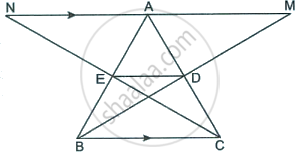
In ΔABC, D and E are the mid-points of AC and AB, respectively. BD and CE produced meet a line through A parallel to BC at M and N, respectively. Prove that AM = AN.
Advertisements
उत्तर
Given: In triangle ABC, D and E are the mid-points of AC and AB respectively. BD and CE produced meet a line through A parallel to BC at M and N respectively.
To Prove: AM = AN
Proof [Step-wise]:
1. Choose a convenient coordinate system:
Put B = (0, 0), C = (2, 0) and A = (x, y) with y ≠ 0.
Choosing BC = 2 is only a scale choice and does not affect equality of lengths.
2. Since E is the midpoint of AB.
`E = ((0 + x)/2, (0 + y)/2)`
= `(x/2, y/2)`
Since D is the midpoint of AC.
`D = ((x + 2)/2, (y + 0)/2)`
= `((x+2)/2, y/2)`
These are midpoint facts; see the midpoint theorem.
3. Parametrize the line BD:
Points on BD are t × D for t ∈ R because B is the origin.
So, a general point on BD has coordinates `(t xx (x + 2)/2, t xx y/2)`.
The line through A parallel to BC is horizontal y = y.
To find M = BD ∩ line through A parallel to BC set the y-coordinate equal to y:
`t xx (y/2) = y`
⇒ t = 2
4. With t = 2 we get
M = 2D
= (x + 2, y)
Hence, the vector AM = M – A
= (x + 2 – x, y – y)
= (2, 0)
So, AM = 2.
5. Parametrize the line CE:
Points on CE are C + s(E – C).
Compute `E - C = (x/2 - 2, y/2 - 0)`.
So, a general point is `(2 + s(x/2 - 2), s xx y/2)`.
Intersect with the horizontal line y = y by solving
`s xx y/2 = y`
⇒ s = 2
6. With s = 2 we get
N = C + 2(E – C)
= 2E – C
= (x – 2, y)
Hence, the vector AN = N – A
= (x – 2 – x, y – y)
= (–2, 0)
So, AN = 2.
7. Therefore, AM = 2 = AN, so AM = AN.
