Advertisements
Advertisements
प्रश्न

In ΔABC, ∠ACB = 90°. seg CD ⊥ side AB and seg CE is angle bisector of ∠ACB.
Prove that: `(AD)/(BD) = (AE^2)/(BE^2)`.
Advertisements
उत्तर
Given, In ΔACB,
m∠ACB = 90°
∵ seg CD ⊥ hypo AB
∴ seg CE is angle bisector ∠ACB.
To prove that: `(AD)/(BD) = (AE^2)/(BE^2)`
Proof: In ΔABC
seg CE is angle bisector of ∠ACB. ......(Given)
∴ `(AC)/(BC) = (AE)/(BE)` ......[Angle bisector theorem]
Squaring on both the sides
`(AC^2)/(BC^2) = (AE^2)/(BE^2)` ......(i)
In ΔACB , m∠ACB = 90°
And seg CD ⊥ hypotenuse AB ......(Given)
∴ CD2 = AD × BD ......[Geometric mean thorem]
Dividing both the sides by BD2
`(CD^2)/(BD^2) = (AD xx BD)/(BD^2)`
`(CD^2)/(BD^2) = (AD)/(BD)` .......(ii)
Now, in the figure
ΔACB ∼ ΔADC ∼ ΔCDB ......(Right-angled triangle similarity property)
Consider,
ΔADC ∼ ΔCDB
`(AC)/(BC) = (DC)/(BD)` ......(c.s.c.t)
`(AC^2)/(BC^2) = (DC^2)/(BD^2)`
∴ `(AC^2)/(BC^2) = (AE^2)/(BE^2) = (AD)/(BD)` .......[From equation (i), (ii) and (iii)]
∴ `(AD)/(BD) = (AE^2)/(BE^2)`
APPEARS IN
संबंधित प्रश्न
Given below is the triangle and length of line segments. Identify in the given figure, ray PM is the bisector of ∠QPR.
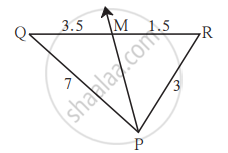
Given below is the triangle and length of line segments. Identify in the given figure, ray PM is the bisector of ∠QPR.
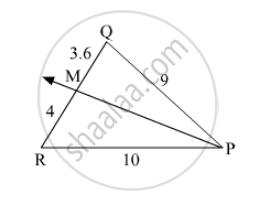
In ∆MNP, NQ is a bisector of ∠N. If MN = 5, PN = 7 MQ = 2.5 then find QP.

Measures of some angles in the figure are given. Prove that `"AP"/"PB" = "AQ"/"QC"`.

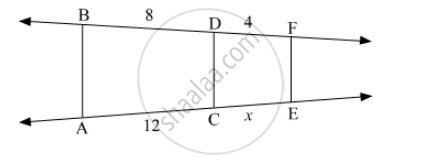
In the given figure, if AB || CD || FE then find x and AE.
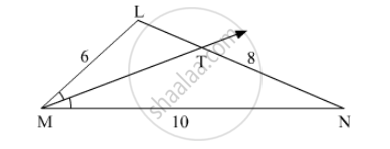
In ∆LMN, ray MT bisects ∠LMN If LM = 6, MN = 10, TN = 8, then Find LT.
In ∆PQR seg PM is a median. Angle bisectors of ∠PMQ and ∠PMR intersect side PQ and side PR in points X and Y respectively. Prove that XY || QR.
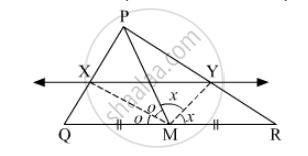
Complete the proof by filling in the boxes.
In △PMQ, ray MX is bisector of ∠PMQ.
∴ `square/square = square/square` .......... (I) theorem of angle bisector.
In △PMR, ray MY is bisector of ∠PMQ.
∴ `square/square = square/square` .......... (II) theorem of angle bisector.
But `(MP)/(MQ) = (MP)/(MR)` .......... M is the midpoint QR, hence MQ = MR.
∴ `(PX)/(XQ) = (PY)/(YR)`
∴ XY || QR .......... converse of basic proportionality theorem.
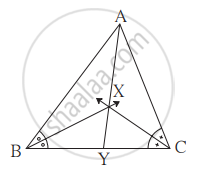
In the given fig, bisectors of ∠B and ∠C of ∆ABC intersect each other in point X. Line AX intersects side BC in point Y. AB = 5, AC = 4, BC = 6 then find `"AX"/"XY"`.
In ▢ABCD, seg AD || seg BC. Diagonal AC and diagonal BD intersect each other in point P. Then show that `"AP"/"PD" = "PC"/"BP"`.

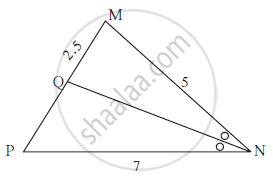
Seg NQ is the bisector of ∠ N
of Δ MNP. If MN= 5, PN =7,
MQ = 2.5 then find QP.
From the top of a light house, an abserver looking at a boat makes an angle of depression of 600. If the height of the lighthouse is 90 m then find how far is the boat from the lighthouse. (3 = 1.73)

In ΔABC, ray BD bisects ∠ABC.
If A – D – C, A – E – B and seg ED || side BC, then prove that:
`("AB")/("BC") = ("AE")/("EB")`
Proof :
In ΔABC, ray BD bisects ∠ABC.
∴ `("AB")/("BC") = (......)/(......)` ......(i) (By angle bisector theorem)
In ΔABC, seg DE || side BC
∴ `("AE")/("EB") = ("AD")/("DC")` ....(ii) `square`
∴ `("AB")/square = square/("EB")` [from (i) and (ii)]
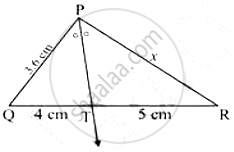
In the following figure, ray PT is the bisector of ∠QPR Find the value of x and perimeter of ∠QPR.
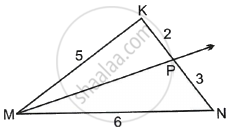
From the information given in the figure, determine whether MP is the bisector of ∠KMN.
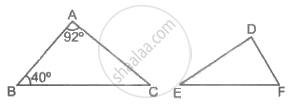
If ΔABC ∼ ΔDEF such that ∠A = 92° and ∠B = 40°, then ∠F = ?
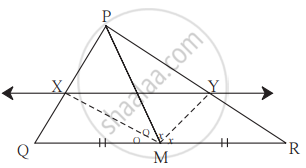
In ∆PQR seg PM is a median. Angle bisectors of ∠PMQ and ∠PMR intersect side PQ and side PR in points X and Y respectively. Prove that XY || QR.
Complete the proof by filling in the boxes.
solution:
In ∆PMQ,
Ray MX is the bisector of ∠PMQ.
∴ `("MP")/("MQ") = square/square` .............(I) [Theorem of angle bisector]
Similarly, in ∆PMR, Ray MY is the bisector of ∠PMR.
∴ `("MP")/("MR") = square/square` .............(II) [Theorem of angle bisector]
But `("MP")/("MQ") = ("MP")/("MR")` .............(III) [As M is the midpoint of QR.]
Hence MQ = MR
∴ `("PX")/square = square/("YR")` .............[From (I), (II) and (III)]
∴ XY || QR .............[Converse of basic proportionality theorem]
