Advertisements
Advertisements
प्रश्न
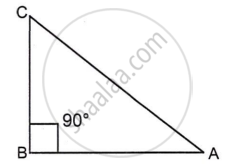
In ΔABC, ∠ABC = 90° C = (2, 0) and B = (−2, 3). If AC = 13 units, find the lengths of BC and AB.
योग
Advertisements
उत्तर
Given
∠ABC = 90° coordinates of C and B, and AC = 13 units.
finding the lengths of BC and AB.
Step 1: Use distance formula to find BC
BC = `sqrt((x_2 − x_1)^2 + (y_2 − y_1)^2)`
Substitute B = (−2, 3) and C = (2, 0)
BC = `sqrt((−2 − 2)^2 + (3 − 0)^2)`
BC = `sqrt((−4)^2 + (3)^2)`
BC = `sqrt(16 + 9)`
BC = `sqrt25`
BC = 5 units
Step 2: Use Pythagoras theorem to find AB
Since ∠ABC = 90°, triangle ABC is a right-angled triangle at B.
By Pythagoras Theorem:
AC2 = AB2 + BC2
Given AC = 13, BC = 5
132 = AB2 + 52
169 = AB2 + 25
AB2 = 144
AB = `sqrt144`
AB = 12 units
shaalaa.com
क्या इस प्रश्न या उत्तर में कोई त्रुटि है?
