Advertisements
Advertisements
प्रश्न
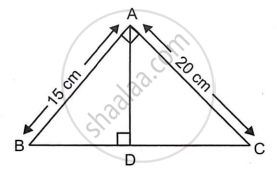
In ΔABC, AB = 15 cm, AC = 20 cm and ∠BAC = 90°. Find the
- area of ΔABC
- length of AD if AD ⊥ BC
- area of ΔABD
Advertisements
उत्तर
Given: In triangle ABC,
- AB = 15 cm
- AC = 20 cm
- ∠BAC = 90° ...(So, triangle ABC is right-angled at A)
i. Find the area of ΔABC:
Step 1: Since ∠BAC = 90°, AB and AC are the perpendicular sides legs of the right triangle.
Step 2: Area of right-angled triangle = `1/2` × base × height
Step 3: Base = AB = 15 cm, Height = AC = 20 cm
Step 4: Area = `1/2 xx 15 xx 20`
= `1/2 xx 300`
= 150 cm2
Area of ΔABC = 150 cm2.
ii. Find the length of AD if AD ⊥ BC ...(AD is the altitude from A to BC)
Step 1: Find BC using Pythagoras theorem:
`BC = sqrt(AB^2 + AC^2)`
= `sqrt(15^2 + 20^2)`
= `sqrt(225 + 400)`
= `sqrt(625)`
= 25 cm
Step 2: Area of ΔABC can also be expressed using base BC and height AD:
`"Area" = 1/2 xx BC xx AD`
Step 3: From the area found above 150 cm2,
`150 = 1/2 xx 25 xx AD`
⇒ 150 = 12.5 × AD
⇒ `AD = 150/12.5`
⇒ AD = 12 cm
Length of AD is 12 cm.
iii. Find the area of ΔABD:
Step 1: Since AD is perpendicular to BC, ΔABD is a right triangle with base BD and height AD.
Step 2: To find BD, use the fact that in a right triangle,
`BD = (AB^2)/(BC)`
= `15^2/25`
= `225/25`
= 9 cm
Step 3: Area of ΔABD
= `1/2 xx BD xx AD`
= `1/2 xx 9 xx 12`
= `1/2 xx 108`
= 54 cm2
Area of ΔABD = 54 cm2.
