Advertisements
Advertisements
प्रश्न
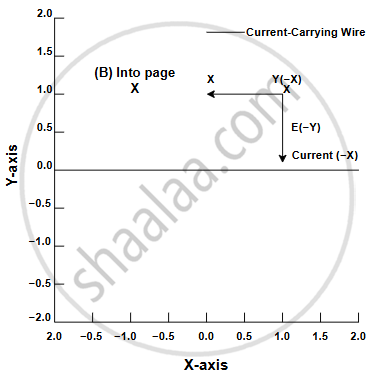
In a region of a uniform electric field `vec E`, a negatively charged particle is moving with a constant velocity `vec v = -v_0 hat i` near a long straight conductor coinciding with XX' axis and carrying current I towards −X axis. The particle remains at a distance d from the conductor.
- Draw diagram showing direction of electric and magnetic fields.
- What are the various forces acting on the charged particle?
- Find the value of vo in terms of E, d and I.
आकृति
विस्तार में उत्तर
Advertisements
उत्तर
i. The graphical ray diagram illustrating the directions of velocity, electric field, and magnetic field.
Electric and Magnetic Field Directions:
ii. The forces acting on the charged particle include:
- Electric Force: FE = qE, where q is the charge of the particle.
- Magnetic Force (Lorentz Force): FB = `q(vec v xx vec B)`, where B is the magnetic field due to the conductor.
- Gravitational Force: FG = mg, where m is the mass of the particle.
iii. The magnetic field due to the conductor at a distance d is given by:
B = `mu_0 I/(2 pi)`
The Lorentz force acting on the charged particle:
qv0B = qE
`(V_0 mu_0 I)/(2 pi d)` = E
Solving for V0:
V0 = `(2 pi d E)/(mu_0I)`
shaalaa.com
क्या इस प्रश्न या उत्तर में कोई त्रुटि है?
