In a group of 80 people, 40 like Indian food, 36 like Chinese food and 27 do not like any kind of these foods. Draw Venn diagram to find: (i) How many like both kinds of food?
Advertisements
प्रश्न
In a group of 80 people, 40 like Indian food, 36 like Chinese food and 27 do not like any kind of these foods. Draw Venn diagram to find:
- How many like both kinds of food?
- How many like only the Indian food?
- How many like only the Chinese food?
[Hint: Let A and B be the sets of those people who like Indian and Chinese food, respectively. Then, we have n(A) = 40, n(B) = 36, n(A ∪ B) = 80 − 27 = 53]
Advertisements
उत्तर
Let U = {all people in the group}, A = {people who like Indian food}, and B = {people who like Chinese food}.
Number of people who like both kinds of food:
n(A ∪ B) = n(A) + n(B) – n(A ∩ B)
53 = 40 + 36 – n(A ∩ B)
53 = 76 – n(A ∩ B)
n(A ∩ B) = 76 – 53
n(A ∩ B) = 23
From the given values:
People who like only Indian food: n(A – B) = 40 – 23 = 17
People who like only Chinese food: n(B – A) = 36 – 23 = 13
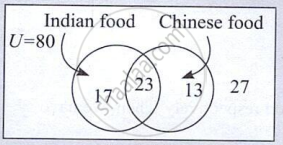
(i) Number of people who like both kinds of food:
So, 23 people like both kinds of food.
(ii) Number of people who like only Indian food:
So, 17 people like only Indian food.
(iii) Number of people who like only Chinese food:
So, 13 people like only Chinese food.
