Advertisements
Advertisements
प्रश्न
Implantation of embryo occurs in ______.
Advertisements
उत्तर
Implantation of embryo occurs in uterus.
Explanation:
After fertilization, the zygote divides repeatedly to form an embryo. The embryo then reaches the uterus and attaches itself to its thick, vascular inner lining (endometrium). This attachment of the embryo to the uterine wall is called implantation.
APPEARS IN
संबंधित प्रश्न
With the help of diagrammatic representation, explain the process of gametogenesis
How is 'oogenesis' markedly different from 'spermatogenesis' with respect to the growth till puberty in the humans?
Draw a sectional view of human ovary and label the different follicular stages, ovum and Corpus luteum.
Explain the development of a secondary oocyte (ovum) in a human female from the embryonic stage upto its ovulation. Name the hormones involved in this process.
Define spermiogenesis.
What is oogenesis?
In case of sexual reproduction, newborn show similarities about characters. Explain this statement with suitable examples.
Define gametogenesis.
Describe the structure of the human ovum with a neat labelled diagram.
The following is the illustration of the sequence of ovarian events (a-i) in a human female.
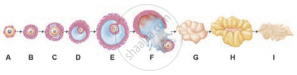
Identify the figure that illustrates ovulation and mention the stage of oogenesis it represents.
The human male gamete is usually about ______ in length.
It The cell division in secondary oocyte is suspended at ______.
Identify the wrong statement from the following.
Cells of corona radiata remain grouped together by ______.
Gray crescent is the area ______.
Head of epididymis is called as ______.
After the release of the secondary oocyte, the Graafian follicle develops into ______.
The number of chromosome groups at the equatorial plate in metaphase-I of meiosis in a plant with 2n = 50 shall be:
The mother germ cells are transformed into a mature follicle through series of steps. Provide the missing steps in the blank boxes.

Given below are two statements.
- Statement I: The spermatids are non-motile and non-functional which get transformed into functional spermatozoa by the process of spermiogenesis.
- Statement II: During the process of this change, the spermatids remain held to each other and to Leydig's cells by cytoplasmic bridges.
In light of the above statements, select the correct answer from the option given below.
