Advertisements
Advertisements
प्रश्न
If x and y are in direct proportion, then (x – 1) and (y – 1) are also in direct proportion.
विकल्प
True
False
Advertisements
उत्तर
This statement is False.
Explanation:
If x and y are in direct proportion, then,
`x/y = k` ...(Constant)
E.g. Let x = 4 and y = 6
∴ `x/y = 4/6 = 2/3`
Now, x – 1 = 4 – 1 = 3 and y – 1 = 6 – 1 = 5
∴ `(x - 1)/(y - 1) = 3/5` ...[Not in direct proportion]
APPEARS IN
संबंधित प्रश्न
Complite the following table given that x varies directly as y .
| x | 6 | 8 | 10 | ... | 20 |
| y | 15 | 20 | ... | 40 | ... |
- How far will it travel in 20 minutes?
- Find the time required to cover a distance of 250 km.
Both u and v vary directly with each other. When u is 10, v is 15, which of the following is not a possible pair of corresponding values of u and v?
An auto rickshaw takes 3 hours to cover a distance of 36 km. If its speed is increased by 4 km/h, the time taken by it to cover the same distance is ______.
In direct proportion, `a_1/b_1` ______ `a_2/b_2`
If the area occupied by 15 postal stamps is 60 cm2, then the area occupied by 120 such postal stamps will be ______.
When two quantities are related in such a manner that, if one increases, the other also increases, then they always vary directly.
It is given that l varies directly as m. Find the constant of proportion (k), when l is 6 then m is 18.
If 25 metres of cloth costs Rs 337.50, then what will be the length of the cloth bought for Rs 810?
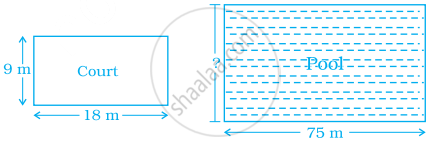
A volleyball court is in a rectangular shape and its dimensions are directly proportional to the dimensions of the swimming pool given below. Find the width of the pool.