Advertisements
Advertisements
प्रश्न
If two straight lines intersect each other, prove that the ray opposite to the bisector of one of the angles thus formed bisects the vertically opposite angle.
Advertisements
उत्तर
Let AB and CD intersect at a point O
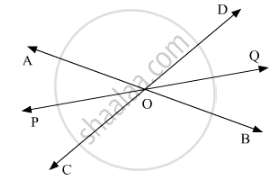
Also, let us draw the bisector OP of ∠AOC.
Therefore,
∠AOP = ∠POC (1)
Also, let’s extend OP to Q.
We need to show that, OQ bisects ∠BOD.
Let us assume that OQ bisects∠BOD, now we shall prove that POQ is a line.
We know that,
∠AOCand ∠DOBare vertically opposite angles. Therefore, these must be equal, that is:
∠AOC = ∠DOB (2)
∠AOPand ∠BOQ are vertically opposite angles. Therefore,
∠AOP = ∠BOQ
Similarly,
∠POC = ∠DOQ
We know that:
∠AOP +∠AOD+∠DOQ+∠POC+∠BOC+∠BOQ = 360°
2∠AOP+∠AOD+2∠DOQ+∠BOC =360°
2∠AOP + 2∠AOD+ 2∠DOQ = 360°
2(∠AOP+∠AOD+ ∠DOQ) = 360°
∠AOP+∠AOD+ ∠DOQ = `(360°)/2`
∠AOP+∠AOD+ ∠DOQ = 180°
Thus, POQ is a straight line.
Hence our assumption is correct. That is,
We can say that if the two straight lines intersect each other, then the ray opposite to the bisector of one of the angles thus formed bisects the vertically opposite angles.
APPEARS IN
संबंधित प्रश्न
If a wheel has six spokes equally spaced, then find the measure of the angle between two adjacent spokes.
An angle is equal to its supplement. Determine its measure.
One angle is equal to three times its supplement. The measure of the angle is
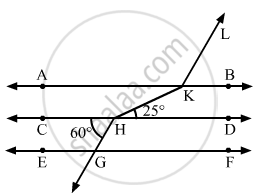
In the given figure, AB || CD || EF and GH || KL. The measure of ∠HKL is
Write the number of endpoints in
(a) a line segment AB
(b) a ray AB
(c) a line AB
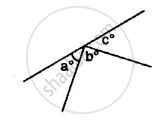
In the adjoining figure, if b° = a° + c°, find b.
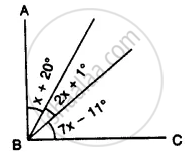
In the given figure, AB is perpendicular to BC at B.
Find:
(i) the value of x.
(ii) the complement of angle x.
Write the complement of `1/2` of a right angle
Write the supplement of x°
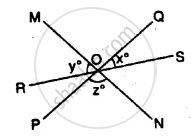
In the given figure, lines PQ, MN, and RS intersect at O. If x : y = 1 : 2 and z = 90°, find ∠ROM and ∠POR.