Advertisements
Advertisements
प्रश्न
If G is the intersection of diagonals of a parallelogram ABCD and O is any point, then \[O \vec{A} + O \vec{B} + O \vec{C} + O \vec{D} =\]
विकल्प
- \[2 \overrightarrow{OG}\]
- \[4 \overrightarrow{OG}\]
- \[5 \overrightarrow{OG}\]
- \[3 \overrightarrow{OG}\]
MCQ
Advertisements
उत्तर
\[4 \overrightarrow{OG}\]
Let us consider the point O as origin.
G is the mid point of AC.
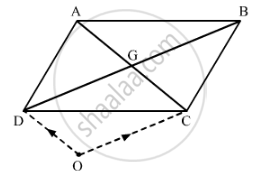
\[\therefore \overrightarrow{OG} = \frac{\overrightarrow{OA} + \overrightarrow{OC}}{2}\]
\[2 \overrightarrow{OG} = \overrightarrow{OA} + \overrightarrow{OC} . . . . . \left( 1 \right)\]
Also, G is the mid point BD
\[\therefore \overrightarrow{OG} = \frac{\overrightarrow{OB} + \overrightarrow{OD}}{2}\]
\[2 \overrightarrow{OG} = \overrightarrow{OB} + \overrightarrow{OD} . . . . . \left( 2 \right)\]
On adding (1) and (2) we get,
\[2 \overrightarrow{OG} + 2 \overrightarrow{OG} = \overrightarrow{OA} + \overrightarrow{OB} + \overrightarrow{OC} + \overrightarrow{OD} \]
\[4 \overrightarrow{OG} = \overrightarrow{OA} + \overrightarrow{OB} + \overrightarrow{OC} + \overrightarrow{OD} \]
\[ \therefore \overrightarrow{OA} + \overrightarrow{OB} + \overrightarrow{OC} + \overrightarrow{OD} = 4 \overrightarrow{OG}\]
Let us consider the point O as origin.
G is the mid point of AC.
\[\therefore \overrightarrow{OG} = \frac{\overrightarrow{OA} + \overrightarrow{OC}}{2}\]
\[2 \overrightarrow{OG} = \overrightarrow{OA} + \overrightarrow{OC} . . . . . \left( 1 \right)\]
Also, G is the mid point BD
\[\therefore \overrightarrow{OG} = \frac{\overrightarrow{OB} + \overrightarrow{OD}}{2}\]
\[2 \overrightarrow{OG} = \overrightarrow{OB} + \overrightarrow{OD} . . . . . \left( 2 \right)\]
On adding (1) and (2) we get,
\[2 \overrightarrow{OG} + 2 \overrightarrow{OG} = \overrightarrow{OA} + \overrightarrow{OB} + \overrightarrow{OC} + \overrightarrow{OD} \]
\[4 \overrightarrow{OG} = \overrightarrow{OA} + \overrightarrow{OB} + \overrightarrow{OC} + \overrightarrow{OD} \]
\[ \therefore \overrightarrow{OA} + \overrightarrow{OB} + \overrightarrow{OC} + \overrightarrow{OD} = 4 \overrightarrow{OG}\]
shaalaa.com
क्या इस प्रश्न या उत्तर में कोई त्रुटि है?
