Advertisements
Advertisements
प्रश्न
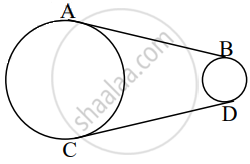
If AB and CD are the common tangents in the circles of two unequal (different) radii, then show that seg AB ≅ seg CD.
Advertisements
उत्तर
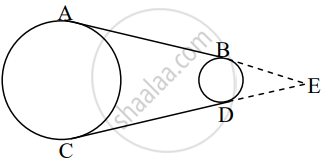
Given: AB and CD are tangents to both circles.
To prove: seg AB ≅ seg CD
Construction: Extend seg AB and seg CD to intersect each other at point E, such that A – B – E, C – D – E.
Proof: In above figure,
`{:(AE = CE),(BE = DE):}}` ...(i) [Tangent segment theorem]
Consider, AE = CE
∴ AB + BE = CD + DE ...[A – B – E, C – D – E]
∴ AB + DE = CD + DE ...[From (i)]
∴ AB = CD
∴ seg AB ≅ seg CD
संबंधित प्रश्न
In the given figure, O is the centre of the circle and B is a point of contact. seg OE ⊥ seg AD, AB = 12, AC = 8, find (1) AD (2) DC (3) DE.

In the given figure, seg EF is a diameter and seg DF is a tangent segment. The radius of the circle is r. Prove that, DE × GE = 4r2
Four alternative answers for the following question is given. Choose the correct alternative.
Length of a tangent segment drawn from a point which is at a distance 12.5 cm from the centre of a circle is 12 cm, find the diameter of the circle.
In the given figure, O is the centre of the circle. Seg AB, seg AC are tangent segments. Radius of the circle is r and `l`(AB) = r, Prove that ▢ABOC is a square. 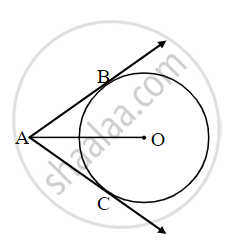
Proof: Draw segment OB and OC.
`l`(AB) = r ...[Given] (i)
AB = AC ...[`square`] (ii)
But OB = OC = r ...[`square`] (iii)
From (i), (ii) and (iii)
AB = `square` = OB = OC = r
∴ Quadrilateral ABOC is `square`
Similarly, ∠OBA = `square` ...[Tangent Theorem]
If one angle of `square` is right angle, then it is a square.
∴ Quadrilateral ABOC is a square.
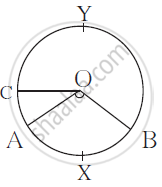
In the following figure ‘O’ is the centre of the circle.
∠AOB = 1100, m(arc AC) = 450.
Use the information and fill in the boxes with proper numbers.
(i) m(arcAXB) =
(ii)m(arcCAB) =
(iv)∠COB =
(iv)m(arcAYB) =
The perpendicular height of a cone is 12 cm and its slant height is 13 cm. Find the radius of the base of the cone.
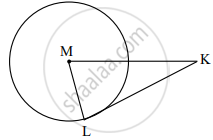
In the given figure, M is the centre of the circle and seg KL is a tangent segment. L is a point of contact. If MK = 12, KL = `6sqrt3`, then find the radius of the circle.
Prove the following theorem:
Tangent segments drawn from an external point to the circle are congruent.
Segment DP and segment DQ are tangent segments to the circle with center A. If DP = 7 cm. So find the length of the segment DQ?

Length of a tangent segment drawn from a point which is at a distance 15 cm from the centre of a circle is 12 cm, find the diameter of the circle?
Tangent segments drawn from an external point to a circle are congruent, prove this theorem. Complete the following activity.

Given: `square`
To Prove: `square`
Proof: Draw radius AP and radius AQ and complete the following proof of the theorem.
In ∆PAD and ∆QAD,
seg PA ≅ `square` ...[Radii of the same circle]
seg AD ≅ seg AD ...[`square`]
∠APD ≅ ∠AQD = 90° ...[Tangent theorem]
∴ ∆PAD ≅ ∆QAD ...[`square`]
∴ seg DP ≅ seg DQ ...[`square`]
In the adjoining figure circle with Centre, Q touches the sides of ∠MPN at M and N. If ∠MPN = 40°, find measure of ∠MQN.

The figure ΔABC is an isosceles triangle with a perimeter of 44 cm. The sides AB and BC are congruent and the length of the base AC is 12 cm. If a circle touches all three sides as shown in the figure, then find the length of the tangent segment drawn to the circle from the point B.

Seg RM and seg RN are tangent segments of a circle with centre O. Prove that seg OR bisects ∠MRN as well as ∠MON with the help of activity.

Proof: In ∆RMO and ∆RNO,
∠RMO ≅ ∠RNO = 90° ...[`square`]
hypt OR ≅ hypt OR ...[`square`]
seg OM ≅ seg `square` ...[Radii of the same circle]
∴ ∆RMO ≅ ∆RNO ...[`square`]
∠MOR ≅ ∠NOR
Similairy ∠MRO ≅ `square` ...[`square`]
In a parallelogram ABCD, ∠B = 105°. Determine the measure of ∠A and ∠D.
