Advertisements
Advertisements
प्रश्न
If 3 and –3 are two zeroes of the polynomial `(x^4 + x^3 – 11x^2 – 9x + 18)`, find all the zeroes of the given polynomial.
Advertisements
उत्तर
Let `x^4 + x^3 – 11x^2 – 9x + 18`
Since 3 and – 3 are the zeroes of f(x), it follows that each one of (x + 3) and (x – 3) is a factor of f(x).
Consequently, `(x – 3) (x + 3) = (x^2 – 9)` is a factor of f(x).
On dividing `f(x) by (x^2 – 9)`, we get:
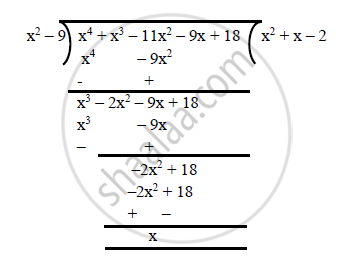
`f(x) = 0 ⇒ (x^2 + x – 2) (x^2 – 9) = 0`
⇒ `(x^2 + 2x – x – 2) (x – 3) (x + 3)`
⇒ `(x – 1) (x + 2) (x – 3) (x + 3) = 0`
⇒ `x = 1 or x = -2 or x = 3 or x = -3`
Hence, all the zeroes are 1, -2, 3 and -3.
APPEARS IN
संबंधित प्रश्न
Find the zeros of the quadratic polynomial 4x2 - 9 and verify the relation between the zeros and its coffiecents.
Find the zeros of the quadratic polynomial 9x2 - 5 and verify the relation between the zeros and its coefficients.
if α and β are the zeros of ax2 + bx + c, a ≠ 0 then verify the relation between zeros and its cofficients
Find the zeroes of the following quadratic polynomial and verify the relationship between the zeroes and the coefficients:
3x2 – x – 4
If 𝛼 and 𝛽 are the zeros of the quadratic polynomial p(x) = 4x2 − 5x −1, find the value of α2β + αβ2.
If α and β are the zeros of the quadratic polynomial f(x) = x2 − p (x + 1) — c, show that (α + 1)(β +1) = 1− c.
If the zeros of the polynomial f(x) = ax3 + 3bx2 + 3cx + d are in A.P., prove that 2b3 − 3abc + a2d = 0.
If the zeros of the polynomial f(x) = x3 − 12x2 + 39x + k are in A.P., find the value of k.
Find the zeroes of the quadratic polynomial `2x^2 ˗ 11x + 15` and verify the relation between the zeroes and the coefficients.
If `x =2/3` and x = -3 are the roots of the quadratic equation `ax^2+2ax+5x ` then find the value of a and b.
If (x+a) is a factor of the polynomial `2x^2 + 2ax + 5x + 10`, find the value of a.
If 1 and –2 are two zeroes of the polynomial `(x^3 – 4x^2 – 7x + 10)`, find its third zero.
If 2 and -2 are two zeroes of the polynomial `(x^4 + x^3 – 34x^2 – 4x + 120)`, find all the zeroes of the given polynomial.
If α, β, γ are the zeros of the polynomial f(x) = ax3 + bx2 + cx + d, then α2 + β2 + γ2 =
The polynomial which when divided by −x2 + x − 1 gives a quotient x − 2 and remainder 3, is
An asana is a body posture, originally and still a general term for a sitting meditation pose, and later extended in hatha yoga and modern yoga as exercise, to any type of pose or position, adding reclining, standing, inverted, twisting, and balancing poses. In the figure, one can observe that poses can be related to representation of quadratic polynomial.


The zeroes of the quadratic polynomial `4sqrt3"x"^2 + 5"x" - 2sqrt3` are:
For the following, find a quadratic polynomial whose sum and product respectively of the zeroes are as given. Also find the zeroes of these polynomials by factorisation.
`-2sqrt(3), -9`
If one of the zeroes of a quadratic polynomial of the form x2 + ax + b is the negative of the other, then it ______.
Find the zeroes of the following polynomials by factorisation method and verify the relations between the zeroes and the coefficients of the polynomials:
`7y^2 - 11/3 y - 2/3`
