Advertisements
Advertisements
प्रश्न
Identify the elasticity of supply for the following with proper reasoning:
Perishable and durable goods.
Advertisements
उत्तर
The supply of perishable commodities is usually inelastic since they cannot be stored for long periods; hence, it cannot adjust quickly to changes in price. Excess perishable items cannot be stored and must be sold immediately to avoid waste. Durable goods have a more elastic supply due to their ability to be kept and modified to price changes without spoiling.
APPEARS IN
संबंधित प्रश्न
Draw a perfectly inelastic supply curve.
With the help of a suitable diagram, explain the following degree of elasticity of supply.
Es = ∞

Identify the elasticity of supply (es) of S1, S2 and S3 supply curves:
If price elasticity of supply is greater than 1, then supply is said be elastic.
- Price elasticity of supply of a good is 0.8, its supply is said to be inelastic.
- If the quantity supplied of a commodity remain the same whatever its price supply is said to perfectly inelastic.
Which of the following statements are true?
The cost of production will increase if
- The government gives subsidies
- The firm uses obsolete technology
- The price of diesel increases
Pick the option which does not belong to the group.
When is the supply of a commodity is called elastic?
The quantity of a commodity supplied increases by 25% when its price rises by 10%. Calculate price elasticity of supply.
Cotton and cotton seeds are examples of ______ supply.
The price of a commodity rises from ₹ 20 to ₹ 40 Consequently, its supply increases from 100 units to 400 units. Calculate price elasticity of supply.
Draw and briefly explain a perfectly elastic supply curve.
Give the meaning of perfectly inelastic supply.
Indicate the degree of elasticity on the supply curve given below:
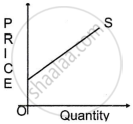
Draw and explain the following degree of elasticity of supply.
Ep > 1
Identify and define the degree of price elasticity of supply from the diagram for the supply curves S1, S2, S3, S4.
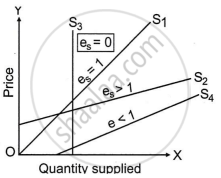
What is meant by elasticity of supply?
If the price of a commodity falls by 10% and consequently, the quantity supplied decreases by 20%, what will be its elasticity of supply?
What do you mean by elastic supply?
