Advertisements
Advertisements
प्रश्न
How does the force of attraction between the two bodies depend upon their masses and the distance between them? A student thought that two bricks tied together would fall faster than a single one under the action of gravity. Do you agree with his hypothesis or not? Comment.
Advertisements
उत्तर
From Newton’s law of gravitation, the force of attraction between two bodies is directly proportional to the product of their masses and inversely proportional to the square of the distance between their centres i.e.,
F α `("m"_1"m"_2)/"d"^2`
The student’s hypothesis is wrong. As acceleration due to gravity is independent of the mass of the falling body, therefore, the two bricks tied together fall with the same speed as the single one to reach the ground at the same time under the action of gravity.
APPEARS IN
संबंधित प्रश्न
What is the value of gravitational constant G (i) on the earth, and (ii) on the moon ?
Right or wrong sentence:
The CGS unit of G is dyne.cm2/g2.
Right or wrong sentence:
As we go above the earth's surface, value of g increases.
Write scientific reasons.
The value of g at the centre of the earth is zero.
The mass of a body on the surface of the earth is 10 kg. The mass of the same body on the surface on the moon is `"g"_"m" = 1/6 "g"_"e"`, where gm, ge acceleration due to gravity on the surface of the moon and the earth respectively.
When the value of acceleration due to gravity 'g' becomes `(g/3)` above the earth's surface at height 'h' then relation between 'h' and 'R' is ______.
R =radius of the earth
At a height R above the earth's surface, the gravitational acceleration is ______.
(R = radius of earth, g = acceleration due to gravity on earth's surface.)
The radius of the orbit of a geostationary satellite is (mean radius of the earth R, angular velocity about an axis in ω and acceleration due to gravity on earth's surface is (g) ______.
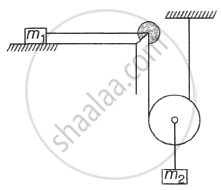
If the surface is smooth, the acceleration of the block m2 will be ______.
The mass of a spaceship is 1000 kg. It is to be launched from the earth's surface out into free space. The value of g and R are 10 m/s2 and 6400 km, respectively. The required energy for this work will be ______.
