Advertisements
Advertisements
प्रश्न
How does sound travel in air?
Advertisements
उत्तर
Sound travels in air as a longitudinal wave through the vibration of air molecules. When a sound source vibrates, it creates compressions (high pressure) and rarefactions (low pressure) that propagate through the air. These pressure variations transfer sound energy from one molecule to another, allowing the wave to travel. The sound reaches our ears, causing the eardrum to vibrate, which is then processed by the brain as sound. Since sound needs a medium, it cannot travel in a vacuum.
APPEARS IN
संबंधित प्रश्न
Name the phenomenon that causes a loud sound when the stem of a vibrating tuning fork is kept pressed on the surface of a table.
Name one property of waves that do not change when the wave passes from one medium to another.
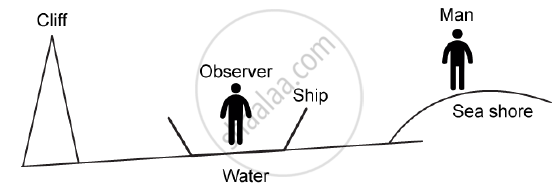
A person is standing at the seashore. An observer on the ship which is anchored in between a vertical cliff and the person on the shore fires a gun. The person on the shore hears two sounds, 2 seconds and 3 seconds after seeing the smoke of the fired gun. If the speed of sound in the air is 320 ms-1 then calculate:
1) the distance between the observer on the ship and the person on the shore.
2) the distance between the cliff and the observer on the ship.
In a longitudinal wave, compression and rarefaction are formed.
How is loudness related to the amplitude of wave?
Two identical guitars are played by two persons to give notes of the same loudness and pitch. Will they differ in quality? Give reason for your answer.
How is the pitch of sound in a guitar changed if (a) thin wire is used, (b) wire under less tension is used?
Explain the following and illustrate your answer by drawing appropriate diagram:
Pitch
Name the factors which determine the quality of a note.
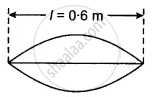
A 0.6 m long stretched wire is made to vibrate in two different modes as shown in figure
(a)
(b)
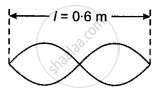
(i) If the frequency of the note produced in (b) is n, what is the frequency in case (a)?
(ii) In which case (a) or (b), is the note louder? Give reasons.
(iii) In which case is the pitch higher? Give reason.
