Advertisements
Advertisements
प्रश्न
How do desert plants and animals differ from most plants and animals?
Advertisements
उत्तर
Desert plants and animals have developed the ability to require less water than most plants and animals.
संबंधित प्रश्न
Answer the question in a short paragraph.
The author has drawn powerful images and pictures. Pick out three examples each of
(i) the atmosphere of ‘febrile confusion’ outside the temple of Pashupatinath (for
example: some people trying to get the priest’s attention are elbowed aside…)
(ii) the things he sees
(iii) the sounds he hears
Thinking about the Poem
Which country or countries do you think “the Northland” refers to?
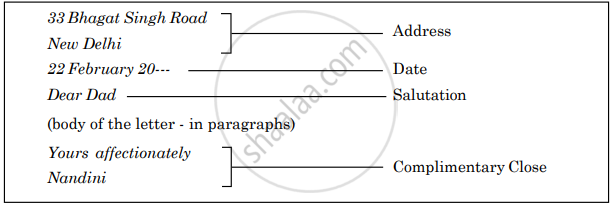
When we write informal letters (to a friend, or to a member of our family), we use this layout.
India's Major concerns
Read the following paragraph. Then work in pairs and list the different ways in which you can contribute to save Mother Earth. As an individual you can make a major contribution towards reducing India's over all emission level.

How to save the Environment at Home
There are plenty of small steps that people can take at home to help save the environment. While the eco-footprint of each step is small, thousands of people doing the same thing can make a difference. In making some small changes to the way that you do things at home, you are gradually making a difference, even as an individual. You will kill costs and improve your health at the same time, so helping to save the environment isn't an entirely altruistic exercise after all!
|
SAVE MOTHER EARTH CAMPAIGN |
Know all about Chess . Read and enjoy :
You now know a little about Koneru Humpychess player but do you know how to play chess? Let's know more about it:
Have you ever played chess? Did you know that chess is the oldest skill game in the world? But chess is more than just a. game of skill. It can tell you much about the way people lived in medieval times. If you look at the way a chess board is set up, then study the pieces and how they are used, you will realise that chess is a history of medieval times in miniature. The six different chess pieces on the board represent a cross section of medieval life with its many ceremonies grandeur ,and wars .
Chess was played many centuries ago in China, India, and Persia. No one really knows for sure in which country it originated. Then, in the eighth century, armies of Arabs known as Moors invaded Persia. The Moors learned chess from the Persians. When the Moors later invaded Spain, the soldiers brought the game of chess with them. Soon the Spanish were playing chess, too. From Spain, the popularity of chess quickly spread throughout all of Europe
Europeans gave chess pieces the names we know today; they probably had trouble pronouncing and spelling the Persian names, so they modernized them to reflect the way they lived. Today, the names certainly aren't modem but a thousand years ago they represented the very way in which both ordinary people and persons of rank lived their lives.
The pawns on the chess board represent serfs, or labourers. There are more of them than any other piece on the board, and often they are sacrificed to save the more valuable pieces. In medieval times, serfs were considered no more than the property of landowners, or chattels. Life was brutally hard for serfs during this era of history. They worked hard and died young. They were often left unprotected while wars raged around them. They could be traded, used as a diversion, or even sacrificed to allow the landowners to escape harm.
The castle piece on a chess board is the home, or the refuge, just as it was a home in medieval times. In Chess, each side has two castles, or rooks, as they are sometimes called.
The knight on a chess board represents the professional soldier of medieval times whose job it was to protect persons of rank, and there are two of them per side in a game of chess. Knights in a game of chess are more important than pawns, but less important than bishops, kings, or queens. Their purpose in the game of chess is to protect the more important pieces, and they can be sacrificed to save those pieces just as pawns can.
There is a bishop in the game of chess, who represents the church. The Church was a rich and mighty force in medieval times, and religion played a large part in every person's life. It is no wonder that a figure that represented the concept of religion found its way into the game. A bishop was the name for a priest in the Catholic church who had risen through the ranks to a more powerful position. In the game of chess, there are two bishops for each side.
The queen is the only piece on the board during a chess game that represents a woman, and she is the most powerful piece of the game.
The king is the tallest piece on the board, and is as well defended on the chessboard as in medieval life. In medieval times, the surrender of the king would mean the loss of the kingdom to invading armies and that could mean change for the worse. It was to everyone's advantage, from the lowest serf to the highest-ranking official, to keep the king safe from harm.. The king is the most important, but not the most powerful piece in chess. If you do not protect your king, you lose the game.
The next time you set up your chessboard and get ready 7 to play a friendly game or two, think of chess as a 6 history lesson. The pieces on the board represent a way 5 of life that is no more, and the real life dramas that occurred in medieval times are now only a game.
The black man's face bespoke revenge
As the fire passed from his sight.
For all he saw in his stick of wood
Was a chance to spite the white.
The last man of this forlorn group
Did nought except for gain.
Giving only to those who gave
Was how he played the game.
Their logs held tight in death's still hands
Was proof of human sin.
They didn't die from the cold without
They died from the cold within.
Read the lines given above and answer the question that follow.
What was the obvious cause of their deaths ?
Some are Purple and gold flecked grey
For she who has journeyed through life midway,
Whose hands have cherished , whose love has blest,
And cradled fair sons on her faithful breast,
And serves her household in fruitful pride,
And worship the gods at her husband's side.
Read the lines given above and answer the question that follow:
What do the purple and grey colours of bangles signify in this stanza?
The women came out on the shore, and made for the stepping—?stones. They had plenty to laugh and bicker about, as they approached the river in a noisy crowd. They girded up their skirts, so as to jump from stone to stone, and they clanked their sickles and forks together over their shoulders to have ease of movement. They shouted their quarrels above the gush of the river. Noise frightens crocodiles. The big mugger did not move, and all the women crossed in safety to the other bank. Here they had to climb a steep hillside to get at the grass, but all fell to with a will, and sliced away at it wherever there was foothold to be had. Down below them ran the broad river, pouring powerfully out from its deep narrow pools among the cold cliffs and shadows, spreading into warm shallows, lit by kingfishers. Great turtles lived there, and mahseer weighing more than a hundred pounds. Crocodiles too. Sometimes you could see them lying out on those slabs of clay over there, but there were none to be seen at the moment.
Read the extract given below and answer the question that follow.
What were they doing on the hill?
So after that, dimly, dimly, she sensed it, she was different and they knew her difference and kept away. There was talk that her father and mother were taking her back to Earth next year; it seemed vital to her that they do so, though it would mean the loss of thousands of dollars to her family. And so, the children hated her for all these reasons of big and little consequence. They hated her pale snow face, her waiting silence, her thinness, and her possible future. “Get away 1” The boy gave her another push. “What’re you waiting for?”Then, for the first time, she turned and looked at him. And what she was waiting for was in her eyes. “Well, don’t wait around here !” cried the boy savagely. “You won’t see nothing!” Her lips moved. “Nothing 1” he cried. “It was all a joke, wasn’t it?” He turned to the other children. “Nothing’s happening today. Is it ?”
Read the extract given below and answer the question that follow.
What was Margot waiting for? Why did William say it was a joke?
Why does Portia disapprove of the County Palatine? Who would she rather marry?
What are the 'present wants'? Who is its need of I~ 'present wants'? Why?
What does Canynge do soon after and what does he find? What was his reaction? What does the discovery; prove?
What were the hermit’s answers to the three questions? Write each answer separately. Which answer do you like most, and why?
Mridu had noticed in front of Meena’s house a pair of chappals. Whom did they belong to?
Who made the pact with the Sun and why? How did the pact prove fruitful?
Give two example of trees that have a number of uses in everybody’s life.
Multiple Choice Question:
The kite rides over _____________
Multiple Choice Question:
Which one of the following is not associated with the real beauty?
Multiple Choice Question:
What does the word ‘scribble’ mean?
Read the following sets of words loudly and clearly.
cot – coat
cost – coast
tossed – toast
got – goat
rot – rote
blot – bloat
knot – note
