Given D(A,B,C,D) = π(2, 3, 4, 5, 11, 12, 13). Use Karnaugh's map to reduce this function D using the given POS form. Draw the logic gate diagram for the reduced POS form. You may use gates with more
Advertisements
प्रश्न
Given D(A,B,C,D) = π(2, 3, 4, 5, 11, 12, 13).
Use Karnaugh's map to reduce this function D using the given POS form. Draw the logic gate diagram for the reduced POS form. You may use gates with more that two inputs. Assume that variables and their complements are available as inputs.
Advertisements
उत्तर
Given: F(A,B,C,D) = Π M(2,3,4,5,11,12,13)
We have to simplify the Boolean function using a 4-variable Karnaugh Map and draw the logic gate diagram for the reduced POS form.
Step 1: Construct the 4-Variable K-Map
Since the function is given in POS form, place 0 at the given maxterms and 1 in the remaining cells.
|
AB \ CD |
00 |
01 |
11 |
10 |
|---|---|---|---|---|
|
00 |
1 |
1 |
0 |
0 |
|
01 |
0 |
0 |
1 |
1 |
|
11 |
0 |
0 |
1 |
1 |
|
10 |
1 |
1 |
0 |
1 |
Step 2: Group the Adjacent 0s
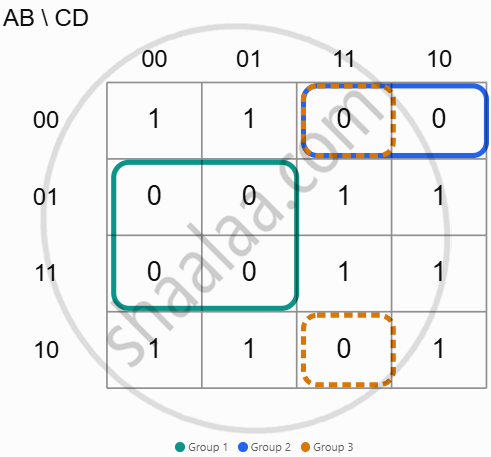
Group 1: Maxterms (4, 5, 12, 13)
Here, B = 1 and C = 0.
Therefore, Group 1 = (B' + C)
Group 2: Maxterms (2, 3)
Here, A = 0, B = 0 and C = 1.
Therefore, Group 2 = (A + B + C')
Group 3: Maxterms (3, 11)
Here, B = 0, C = 1 and D = 1.
Therefore, Group 3 = (B + C' + D')
Step 3: Write the Reduced POS Expression
Combining all three groups:
F = (B' + C)(A + B + C')(B + C' + D')
Reduced POS Form:
F(A,B,C,D) = (B' + C)(A + B + C')(B + C' + D')
Step 4: Draw the Logic Gate Diagram for the Reduced POS Form
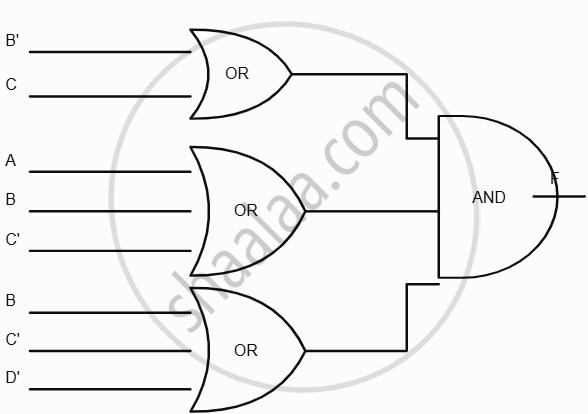
Working of the Logic Circuit:
- OR Gate 1 takes B' and C as inputs and produces (B' + C).
- OR Gate 2 takes A, B and C' as inputs and produces (A + B + C').
- OR Gate 3 takes B, C' and D' as inputs and produces (B + C' + D').
- The 3-input AND gate combines the outputs of all three OR gates.
