Advertisements
Advertisements
प्रश्न
Given below is a set of six experimental set-ups (A-F), kept in this state for about 24 hours.
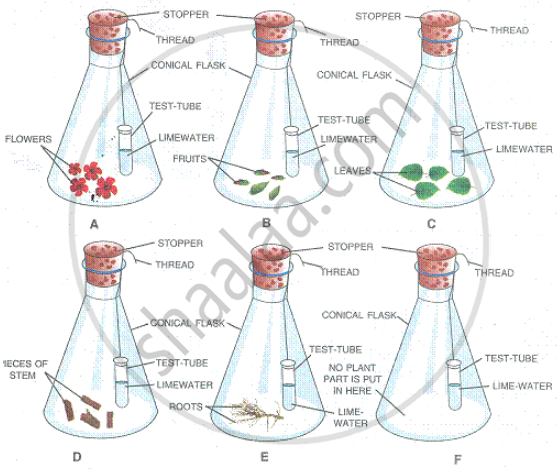
In which tube/tubes the limewater will turn milky?
Advertisements
उत्तर
All the five flasks (A-E) containing plant parts will show respiration and thus, the tubes containing limewater will turn milky. The flask F does not contain any plant part. So, there is no respiration and hence, there is no change.
APPEARS IN
संबंधित प्रश्न
Describe one experiment you would perform to demonstrate the following phenomena: The germinating seeds to give out carbon dioxide.
Describe one experiment each of you would perform to demonstrate the following phenomena: The germinating seeds can respire even in a total absence of air.
The following diagram refers to an apparatus which is used to demonstrate a physiological process:

Why has the coloured water risen in tubing 1?
In order to study and prove a particular physiological process in plants, the following experiment was set up. Study the same and then answer the question that follows:

What is the function of soda lime in the bottle 'A' and why is limewater placed in bottle 'B'?
In order to study and prove a particular physiological process in plants, the following experiment was set up. Study the same and then answer the question that follow:
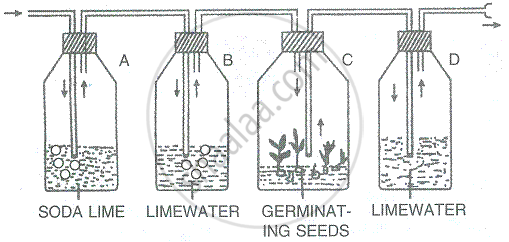
What change would you expect to observe in bottle 'D'?
In order to study and prove a particular physiological process in plants, the following experiment was set up. Study the same and then answer the question that follow:
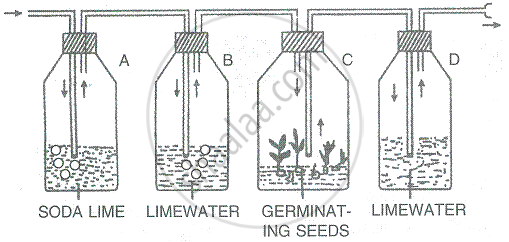
Represent the physiological process named in question 4.1 in the form of a chemical equation.
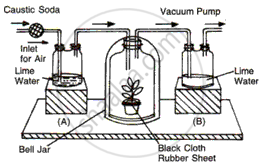
Given alongside is an experimental set up to demonstrate a phenomenon in a plant:
(a) What is the aim of this experiment?
(b) Why was the bell jar covered with a black cloth?
(c) What is the function of caustic soda in this experiment?
(d) Give an overall chemical equation of the process mentioned in (a) above.
(e) Mention one precaution that should be taken to ensure more accurate results. What change, if any, would you observe in the lime water in Flask A and B? In each case give a reason for your answer.
The given fig. refers to an apparatus which is used to demonstrate a physiological process:
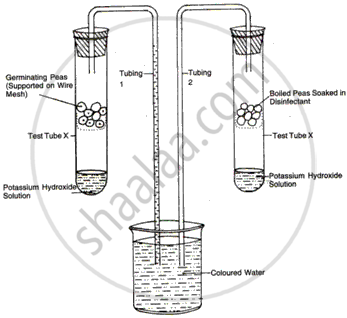
(a) What is the purpose of keeping potassium hydroxide solution in test tubes X and Y?
(b) What is the purpose of keeping boiled peas soaked in disinfectant in test tube Y?
(c) Why has coloured water risen in tube 1?
(d) Name the biological process which causes the above rise.
(e) Define the biological process shown in the experiment.
Name the following:
The chemicals generally used to absorb carbon dioxide in respiratory experiments.
Name the following:
The solution that turns milky when carbon dioxide is passed through that solution.
