Advertisements
Advertisements
प्रश्न
Given alongside are the diagrammatic sketches of some endocrine glands. Observe the figures and answer the following questions:
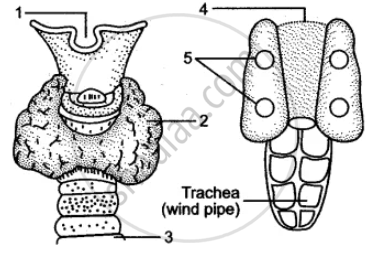
(i) Label the parts numbered 1 to 5.
(ii) Name the hormones secreted by (2) and (5).
(iii) Which chemicals in our body are greatly affected by hormones?
(iv) What is the chemical nature of hormones?
(v) Name the elements related to the functioning of hormones secreted by the structure (2) and (5).
Advertisements
उत्तर
(i)
1. Larynx.
2. Left lobe of the thyroid gland.
3. Trachea (windpipe).
4. Oesophagus.
5. Parathyroid glands.
(ii) Structure (2) secretes thyroxin hormone and structure (5) secretes parathormone.
(iii) Enzymes; which constitute the enzyme system of the body.
(iv) Hormones may be proteins, amino acids or steroids.
(v) Iodine is related to the functioning of glands (2) calcium, phosphorus is related to the functioning of the gland (5).
संबंधित प्रश्न
Give an example of a progestational hormone.
State whether the following statement is true or false. If false, rewrite changing the word.
The pituitary gland is both exocrine and endocrine in function.
Differentiate: Hormones and Enzyme.
Differentiate: Gigantism and Acromegaly.
Give the Technical Term: Name the hormones which lead to the following condition: Growth of beard in women
The sketch below shows a certain condition in an individual:

(i) Name the condition.
(ii) What is the underlying cause of this condition?
(iii) Name two other conditions that could have resulted due to a similar cause.
(iv) Which hormone is required for iodine synthesis?
(v) Where is the thyroid gland located?
(vi) The hormone secreted by the thyroid gland is controlled from which hormone?
Choose the Odd One Out
Choose the Odd One Out.
Column ‘II’ is a list of items related to ideas in Column ‘I’. Match the term in Column ‘II’ with a suitable idea given in Column ‘I’.
| Column A | Column B |
| (i) Pituitary | (a) produces male sex characteristics |
| (ii) Ovaries | (b) decreases blood sugar level |
| (iii) Thyroid | (c) increases heart and breathing rate raises blood pressure |
| (iv) Thymus | (d) produces female sex characteristics |
| (v) Adrenals | (e) is known as emergency hormone |
| (vi) Hypothalamus | (f) regulates the level of calcium and phosphorus |
| (vii) Pancreas | (g) increases the rate of metabolism |
| (viii) Testes | (h) maintains the level of calcium |
| (ix) Parathyroid | regulates the amount of water excreted in the urine. |
| (x) Cretinism | (j) simulates skeletal growth |
| (xi) Diabetes mellitus | (k) regulates the activities of other glands |
| (xii) Insulin shock | (l) stimulates the development of male and female sex organs |
| (xiii) Gigantism | (m) Shortage of glucose in the blood. |
| (xiv) Enlargement of breasts in adult males | (n) Over-secretion of growth hormone |
| (xv) Exophthalmic goiter | (o) Excess of glucose in the blood |
| (xvi) Acromegaly | (p) Over-secretion of thyroxin |
| (xvii) Addison’s disease | (q) Dwarfism and mental retardation |
| (xviii)Cretinism | (r) Over-secretion of cortical hormones |
| (xix) Dwarfism | (s) Under-secretion of the adrenal cortex |
| (xx) Adrenalin | (t) Under-secretion of thyroxin in children |
| (xxi) Vasopressin | (u) Over-secretion of growth hormones in adults |
Briefly explain the structure of thyroid gland.
