Advertisements
Advertisements
प्रश्न
Given a rhombus ABCD in which AB = 4 cm and ∠ABC = 60°, divide it into two triangles say ABC and ADC. Construct the triangle AB'C' similar to ΔABC with scale factor `2/3`. Draw a line segment C'D' parallel to CD where D' lies on AD. Is AB'C'D' a rhombus? Give reasons.
Advertisements
उत्तर
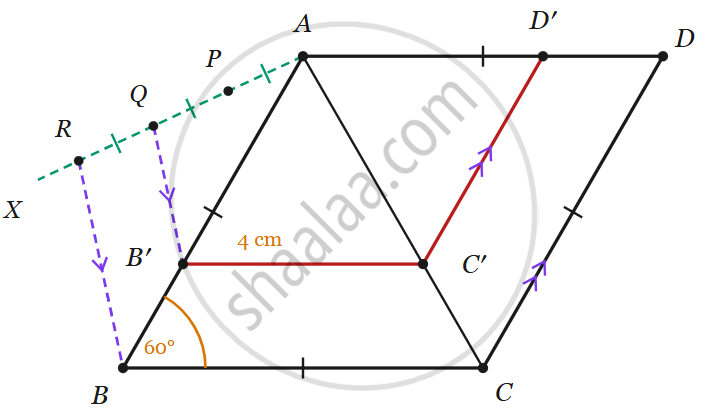
\[ \begin{array}{r l} \textbf{Given:} & \text{A rhombus } ABCD \text{ with } AB = 4 \text{ cm and } \angle ABC = 60^\circ, \text{ divided by the diagonal } AC \text{ into the triangles } ABC \text{ and } ADC. \\[4pt] \textbf{To Find:} & \text{Whether } AB'C'D' \text{ is a rhombus, where } \triangle AB'C' \text{ is similar to } \triangle ABC \text{ with scale factor } \dfrac{2}{3} \text{ and } C'D' \text{ is parallel to } CD \text{ with } D' \text{ on } AD. \\[4pt] \textbf{Solution:} & \text{Step 1: Draw } BC = 4 \text{ cm, construct } \angle ABC = 60^\circ, \text{ cut off } BA = 4 \text{ cm, complete the rhombus } ABCD \text{ and join the diagonal } AC. \\[4pt] & \text{Step 2: Draw a ray } AX \text{ making an acute angle with } AB \text{ on the side opposite to } C, \text{ and mark three points } P, Q, R \text{ on it with } AP = PQ = QR. \\[4pt] & \text{Step 3: Join } RB \text{ and through } Q \text{ draw a line parallel to } RB, \text{ meeting } AB \text{ at } B'; \text{ through } B' \text{ draw a line parallel to } BC, \text{ meeting } AC \text{ at } C'. \\[4pt] & \text{Step 4: Through } C' \text{ draw a line parallel to } CD, \text{ meeting } AD \text{ at } D'. \\[4pt] & \text{Justification: all sides of a rhombus are equal, hence } AB = BC = CD = DA = 4 \text{ cm.} \\[4pt] & \text{In triangle } ACD, \text{ since } C'D' \text{ is parallel to } CD, \text{ the Basic Proportionality Theorem gives } \dfrac{AD'}{AD} = \dfrac{AC'}{AC} = \dfrac{2}{3}, \text{ and the triangles } AC'D' \text{ and } ACD \text{ are similar by the AA criterion.} \\[4pt] & \begin{aligned} AB' = B'C' = C'D' = D'A &= \frac{2}{3} \times 4 \\[4pt] &= \frac{8}{3} \\[4pt] &\approx 2.67 \end{aligned} \\[4pt] \textbf{Answer:} & \text{Yes, } AB'C'D' \text{ is a rhombus, since it is a quadrilateral whose four sides are all equal to } \dfrac{8}{3} \text{ cm} \approx 2.67 \text{ cm.} \end{array} \]
