Advertisements
Advertisements
प्रश्न
Give two examples for the following case:
Physical changes which are not reversible
Advertisements
उत्तर
- Cutting of paper
- Breaking of glass
APPEARS IN
संबंधित प्रश्न
State whether the following is physical or chemical change.
Digestion of food —
Solve this crossword by using the clues that follow-
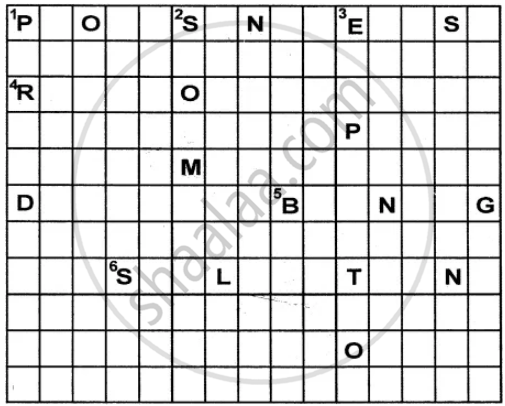
Across
1. Energy in the form of sunlight is absorbed by the green plants in this process.
4. The reddish-brown substance formed over iron in the presence of oxygen and moisture.
5. This change is permanent and irreversible.
6. The process in which a solid directly changes into gaseous state.
Down
1 . It is the change that takes place in case of swinging pendulum of a clock. –
2. Occurrence of this is a non-periodic change as well as a natural change.
3. It is a physical change.
Classify the following as physical or chemical change :
Condensation of steam
Fill in the blank.
A change, which alters the composition of a substances, is known as a___________ change.
Give three reasons why melting of wax, is considered a physical change while burning of a candle, a chemical change.
Name the following:
The final product of the physical change involved during the ‘melting of a piece of wax’.
A change in which matter undergoes a change but the total mass of the substance is unaltered is a ______ change.
Fill in the blanks in the following statements using the words given in the box.
| rusted, colourful, substance, chemical, physical, reversible, iron oxide, object |
- Making sugar solution is a ______ change.
- A physical change is generally ______.
- Grinding of wheat grain changes its size. It is a ______ change.
- Iron benches kept in lawns and gardens get ______. It is a ______ change because a new ______ is formed.
Mention a few physical properties of a substance.
Explain the characteristics of physical change with examples.
