Advertisements
Advertisements
प्रश्न
Give the significance of respiration
Advertisements
उत्तर
1)Respiration provides energy for biosynthesis of cellular materials such as carbohydrates, proteins, fats, lipids, vitamins, pigments, etc
2) It is also a source of energy for cell division, growth, repairs and replacement of worn out parts, movements, locomotion etc.
3) Various intermediates of Krebs cycle are used as building blocks for the synthesis of other complex compounds.
4) Coupled with photosynthesis, it helps to maintain the balance between CO2 and O2 in the atmosphere
5) Anaerobic respiration (fermentation) is used in various industries such as dairies, bakeries, distilleries, leather industries, paper industries, etc. It is used in the commercial production of alcohol, organic acids, vitamins, antibiotics etc.
6) The energy of respiration is also used to convert insoluble substances into the soluble form.
APPEARS IN
संबंधित प्रश्न
Fill in the blanks.
Sweat serves to excrete excess _________ and ________.
What happens to Oxygen after it enters the lungs?
Give the functions of the following:
Cartilaginous rings
Note the relationship between the first two words and suggest a suitable word for the fourth place.
Lungs __ Respiration, Alveoli __ ______.
The question has four options. Choose the correct answer:
During respiration, the diaphragm
Very short answer question.
Name the organ which prevents the following the entry of food into the trachea while eating.
Carefully study the diagram of the human respiratory system with labels A, B, C and D. Select the option which gives correct identification and main function and /or characteristic.
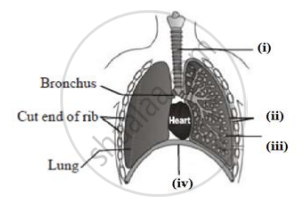
List the parts of the respiratory system.
Which one of the following is a part of the human lower respiratory system?
