Advertisements
Advertisements
प्रश्न
Give scientific reasons: We cannot distinguish colours in moonlight.
Advertisements
उत्तर
Cone cells in the retina are responsibe for colour vision. They are functional only in bright light. Moon light is unable to stimulate the cone cells; however, the rod cells respond to dim light. Hence, we can see in moon light but cannot distinguish colours.
APPEARS IN
संबंधित प्रश्न
Deafness is causal due to the rupturing of the Pinna.
State the main function of the Suspensory ligament of the eye
Perilymph or endolymph (Which one surrounds the organ of Corti?)
Mention, where in living organism is the following located and state their main function:
Organ of corti
With reference to the human ear, answer the question that follow:
Name the three small bones present in the middle ear. What is the biological term for them collectively ?
Choose the Odd One Out:
Verify experimentally the laws reflection of sound.
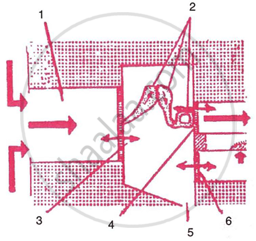
Given below is a diagrammatic representation of a part of the human ear.
- Name the parts numbered 1-6.
- Which parts of the ear shown here are complete.
 |
The part of the inner ear which is responsible for hearing is ______.
- Draw a neat and well labelled diagram of the membranous labyrinth found in the inner ear.
- Based on the diagram drawn above in (i), give a suitable term for each of the following descriptions:
- The structure responsible for hearing.
- The sensory cells that help in hearing.
- The membrane-covered opening that connects the middle ear to inner ear.
- The nerves that carry impulses from the ear to the brain.
- The tube which equalises the air pressure on either side of the ear drum.
