Advertisements
Advertisements
प्रश्न
Give a definition of the following term. Are there other terms that need to be defined first? What are they, and how might you define them?
parallel lines
Advertisements
उत्तर
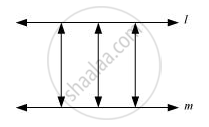
If the perpendicular distance between two lines is always constant, then these are called parallel lines. In other words, the lines which never intersect each other are called parallel lines.
To define parallel lines, we must know about the points, lines, and the distance between the lines and the point of intersection.
APPEARS IN
संबंधित प्रश्न
Give a definition of the following term. Are there other terms that need to be defined first? What are they, and how might you define them?
perpendicular lines
The total number of propositions in the Elements are ______.
Boundaries of solids are ______.
In Indus Valley Civilisation (about 3000 B.C.), the bricks used for construction work were having dimensions in the ratio ______.
The number of interwoven isosceles triangles in Sriyantra (in the Atharvaveda) is ______.
Thales belongs to the country ______.
Pythagoras was a student of ______.
If a quantity B is a part of another quantity A, then A can be written as the sum of B and some third quantity C.
Solve the following question using appropriate Euclid’s axiom:
In the following figure, we have ∠ABC = ∠ACB, ∠3 = ∠4. Show that ∠1 = ∠2.

Read the following statement :
An equilateral triangle is a polygon made up of three line segments out of which two line segments are equal to the third one and all its angles are 60° each.
Define the terms used in this definition which you feel necessary. Are there any undefined terms in this? Can you justify that all sides and all angles are equal in a equilateral triangle.
