Advertisements
Advertisements
प्रश्न
Ganesh and Dinga want to pack 4000-centimeter cubes inboxes. These are to be sent to a school. There are three different boxes available for packing.

- How can Ganesh and Dinga test their guesses before packing the cubes in the boxes? Discuss with your friend.
Advertisements
उत्तर
- In the first layer of box B, we can keep 11 × 11 = 121 cubes.
There are 10 such layers.
So, in box B, we can arrange 10 × 121 = 1210 cubes - In the first layer of box C, we can keep 15 × 9 = 135 cubes.
There are 10 such layers.
So, in box C, we can arrange 10 × 135 = 1350 cubes. - In all three boxes, we can arrange 1200 + 1210 + 1350 = 3760 cubes
So, 3760-centimetre cubes in total can be packed in three boxes.
संबंधित प्रश्न
What will be the volume of a cube having length of edge 7.5 cm?
Find the volume of a cube whose side is 5 cm
Find the volume of a cube whose side is 3.5 m
A cubical milk tank can hold 125000 litres of milk. Find the length of its side in metres
Find the number of bricks of dimension 20 cm × 5 cm × 10 cm required to construct a wall of dimension 300 cm × 200 cm × 20 cm
How many sack of dimension 15 cm × 45 cm × 90 cm filled with rice can be kept in a room of dimension 3 m × 18 m × 9 m
The volume of the paper cube is same as __________ cm cubes.
Ganesh and Dinga want to pack 4000-centimeter cubes inboxes. These are to be sent to a school. There are three different boxes available for packing.
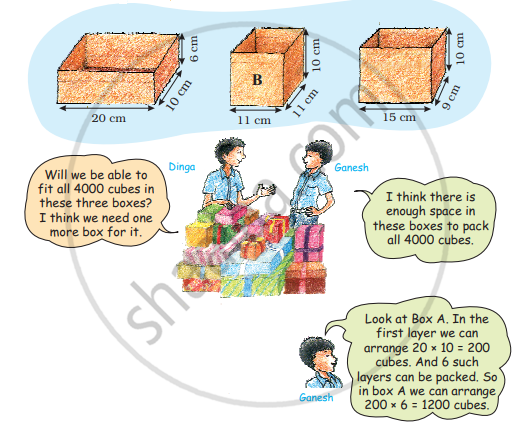
- What is your guess? Who is right?
Ganesh and Dinga want to pack 4000-centimeter cubes inboxes. These are to be sent to a school. There are three different boxes available for packing.

Use Ganesh's method and write:
- _____ centimeter cubes can be arranged in box B.
- _____ centimeter cubes can be arranged in box C.
- So _____ centimeter cubes in all can be packed in the three boxes.
How many cubes each of side 0.5 cm are required to build a cube of volume 8 cm3?
