Advertisements
Advertisements
प्रश्न
From given figure, In ∆ABC, AD ⊥ BC, then prove that AB2 + CD2 = BD2 + AC2 by completing activity.
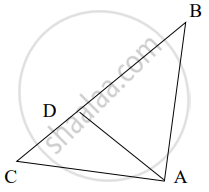
Activity: From given figure, In ∆ACD, by pythagoras theorem
AC2 = AD2 + `square`
∴ AD2 = AC2 – CD2 ...(I)
Also, In ∆ABD, by pythagoras theorem,
AB2 = `square` + BD2
∴ AD2 = AB2 – BD2 ...(II)
∴ `square` – BD2 = AC2 – `square`
∴ AB2 + CD2 = AC2 + BD2
Advertisements
उत्तर
From given figure, In ∆ACD, by pythagoras theorem
AC2 = AD2 + \[\boxed{CD^2}\]
∴ AD2 = AC2 – CD2 ...(I)
Also, In ∆ABD, by pythagoras theorem,
AB2 = \[\boxed{AD^2}\] + BD2
∴ AD2 = AB2 – BD2 ...(II)
∴ \[\boxed{AB^2}\] − BD2 = AC2 − \[\boxed{CD^2}\] ...[From (I) and (II)]
∴ AB2 + CD2 = AC2+ BD2
APPEARS IN
संबंधित प्रश्न
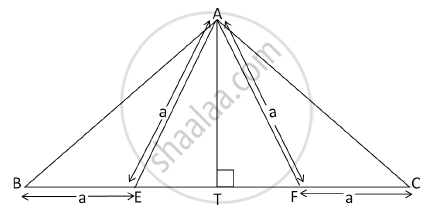
In the following figure, AE = EF = AF = BE = CF = a, AT ⊥ BC. Show that AB = AC = `sqrt3xxa`
Find the length of the side and perimeter of an equilateral triangle whose height is `sqrt3` cm.
∆ABC is an equilateral triangle. Point P is on base BC such that PC = `1/3`BC, if AB = 6 cm find AP.
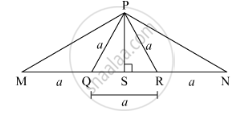
From the information given in the figure, prove that PM = PN = \[\sqrt{3}\] × a
Find the length of the hypotenuse in a right angled triangle where the sum
of the squares of the sides making right angle is 169.
(A)15 (B) 13 (C) 5 (D) 12
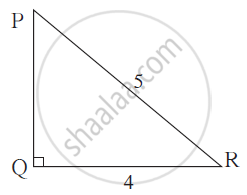
In right angled triangle PQR,
if ∠ Q = 90°, PR = 5,
QR = 4 then find PQ and hence find tan R.
Choose the correct alternative:
ΔABC and ΔDEF are equilateral triangles. If ar(ΔABC): ar(ΔDEF) = 1 : 2 and AB = 4, then what is the length of DE?
A ladder 10 m long reaches a window 8 m above the ground. Find the distance of the foot of the ladder from the base of wall. Complete the given activity.
Activity: As shown in figure suppose
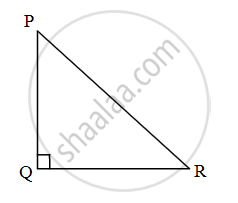
PR is the length of ladder = 10 m
At P – window, At Q – base of wall, At R – foot of ladder
∴ PQ = 8 m
∴ QR = ?
In ∆PQR, m∠PQR = 90°
By Pythagoras Theorem,
∴ PQ2 + `square` = PR2 ...(I)
Here, PR = 10, PQ = `square`
From equation (I)
82 + QR2 = 102
QR2 = 102 – 82
QR2 = 100 – 64
QR2 = `square`
QR = 6
∴ The distance of foot of the ladder from the base of wall is 6 m.
Complete the following activity to find the length of hypotenuse of right angled triangle, if sides of right angle are 9 cm and 12 cm.
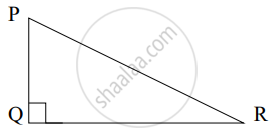
Activity: In ∆PQR, m∠PQR = 90°
By Pythagoras Theorem,
PQ2 + `square` = PR2 ...(I)
∴ PR2 = 92 + 122
∴ PR2 = `square` + 144
∴ PR2 = `square`
∴ PR = 15
∴ Length of hypotenuse of triangle PQR is `square` cm.
From given figure, In ∆PQR, If ∠QPR = 90°, PM ⊥ QR, PM = 10, QM = 8, then for finding the value of QR, complete the following activity.
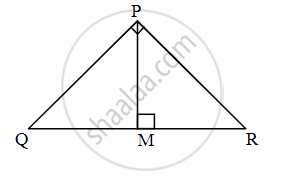
Activity: In ∆PQR, If ∠QPR = 90°, PM ⊥ QR, ...(Given)
In ∆PMQ, By Pythagoras Theorem,
∴ PM2 + `square` = PQ2 ...(I)
∴ PQ2 = 102 + 82
∴ PQ2 = `square` + 64
∴ PQ2 = `square`
∴ PQ = `sqrt(164)`
Here, ∆QPR ~ ∆QMP ~ ∆PMR
∴ ∆QMP ~ ∆PMR
∴ `(PM)/(RM) = (QM)/(PM)`
∴ PM2 = RM × QM
∴ 102 = RM × 8
RM = `100/8 = square`
And,
QR = QM + MR
QR = `square` + `25/2 = 41/2`
Find the diagonal of a rectangle whose length is 16 cm and area is 192 sq. cm. Complete the following activity.
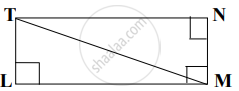
Activity: As shown in the figure, LMNT is a rectangle.
∴ Area of rectangle = length × breadth
∴ Area of rectangle = `square` × breadth
∴ 192 = `square` × breadth
∴ Breadth = 12 cm.
Also, ∠TLM = 90° ...(Each angle of reactangle is right angle)
In ∆TLM, By Pythagoras theorem
∴ TM2 = TL2 + `square`
∴ TM2 = 122 + `square`
∴ TM2 = 144 + `square`
∴ TM2 = 400
∴ TM = 20
A congruent side of an isosceles right angled triangle is 7 cm, Find its perimeter.
ΔPQR, is a right angled triangle with ∠Q = 90°, QR = b, and A(ΔPQR) = a. If QN ⊥ PR, then prove that QN = `(2ab)/sqrt(b^4 + 4a^2)`
