Advertisements
Advertisements
प्रश्न
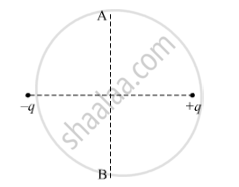
A charge 'q' is moved from a point A above a dipole of dipole moment 'p' to a point B below the dipole in equatorial plane without acceleration. Find the work done in the process.
Advertisements
उत्तर
The net force on the charge q is directed parallel to the dipole and hence perpendicular to its motion along AB.
∴ Work done = 0
APPEARS IN
संबंधित प्रश्न
Show that the orbital magnetic dipole moment of a revolving electron is `(eVr)/2`
Draw the diagrams showing the dipole moments in paramagnetic substance when external magnetic field is (a) absent (b) strong
Do two distinct poles actually exist at two nearby points in a magnetic dipole?
A circular loop carrying a current is replaced by an equivalent magnetic dipole. A point on the loop is in ______.
Two short magnets of equal dipole moments M are fastened perpendicularly at their centre in the Figure . The magnitude of the magnetic field at a distance d from the centre on the bisector of the right angle is

Pick the correct options.
(a) Magnetic field is produced by electric charges only
(b) Magnetic poles are only mathematical assumptions having no real existence
(b) A north pole is equivalent to a clockwise current and a south pole is equivalent to an anticlockwise current.
(d) A bar magnet is equivalent to a long, straight current.
A horizontal circular loop carries a current that looks clockwise when viewed from above. It is replaced by an equivalent magnetic dipole consisting of a south pole S and a north pole N.
(a) The line SN should be along a diameter of the loop.
(b) The line SN should be perpendicular to the plane of the loop
(c) The south pole should be slow the loop
(d) The north pole should be below the loop
The magnetic moment vectors µs and µl associated with the intrinsic spin angular momentum S and orbital angular momentum l, respectively, of an electron are predicted by quantum theory (and verified experimentally to a high accuracy) to be given by:
µs = –(e/m) S,
µl = –(e/2m) l
Which of these relations is in accordance with the result expected classically? Outline the derivation of the classical result.
The orbital speed of an electron orbiting around a nucleus in a circular orbit of radius 50 pm is 2.2 × 10⁶ ms−1. Then the magnetic dipole moment of an electron is:
