Advertisements
Advertisements
प्रश्न
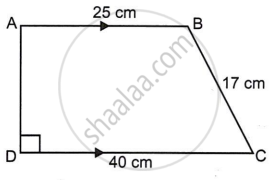
Find the area of the following trapezium.
Advertisements
उत्तर
Given:
- Trapezium ABCD with AB = 25 cm, BC = 17 cm and DC = 40 cm.
- AD is perpendicular to DC right angle at D.
Step 1: Identify that AD is perpendicular to DC, so AD is the height (h) of the trapezium.
We need to calculate the height AD.
Step 2: In right triangle B C D, use Pythagoras theorem to find AD.
Since BC = 17 cm, DC = 40 cm and AD is perpendicular to DC, AD can be found using the right triangle A D C if we find the length of AD.
Step 3: Use triangle ABD right triangle where AB = 25 cm (top base) and DC = 40 cm (bottom base).
Height AD is to be calculated using triangle B C D.
Step 4: Calculate height AD.
Let height AD = h.
In triangle B C D, BD is the hypotenuse and sides are BC = 17 cm and DC = 40 cm minus AB = 25 cm the portion of DC adjacent to AB.
So, `BD = sqrt((DC - AB)^2 + BC^2)`
= `sqrt((40 - 25)^2 + 17^2)`
= `sqrt(15^2 + 17^2)`
= `sqrt(225 + 289)`
= `sqrt(514)`
However, a simpler approach is to note that AD is perpendicular to DC, so AD is the height.
Step 5: Using Pythagoras theorem in triangle ABD:
The base BD = ?
Need to calculate AD:
Given the right angle at D, triangle ADC is right angled.
Using Pythagoras theorem:
AD2 + DC2 = AC2, but AC is not given.
Alternatively, since AB is parallel to DC, the area formula for trapezium is:
Area = `1/2`× sum of parallel sides × height
Here, parallel sides are AB = 25 cm and DC = 40 cm.
We need height AD.
Step 6: To find height AD, apply Pythagoras theorem in triangle B C D noting BD2 = BC2 + CD2:
Given right angle at D, triangle ADC is right angled AD2 + DC2 = AC2.
Still missing length of AC.
Step 7: Another approach: Since AB is parallel and length 25 cm and DC is 40 cm, the difference is 15 cm.
Length BC = 17 cm.
Let the perpendicular distance (height) between the two parallel sides be h.
Now, in triangle B C D:
Using Pythagoras theorem to find height h:
`H = sqrt(BC^2 - (DC - AB)^2)`
= `sqrt(17^2 - (40 - 25)^2)`
= `sqrt(289 - 15^2)`
= `sqrt(289 - 225)`
= `sqrt(64)`
= 8 cm
Step 8: Calculate area of trapezium:
Area = `1/2`× sum of parallel sides × height
= `1/2 xx (25 + 40) xx 8`
= `1/2 xx 65 xx 8`
= 32.5 × 8
= 260 cm2
The area of the trapezium ABCD is 260 cm2.
