Advertisements
Advertisements
प्रश्न
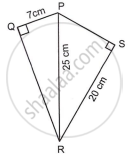
Find the area of quadrilateral PQRS where ∠Q = ∠S = 90° and PQ = 7 cm, PR = 25 cm and RS = 20 cm.
Advertisements
उत्तर
Given:
- Quadrilateral PQRS with ∠Q = ∠S = 90°
- PQ = 7 cm
- PR = 25 cm
- RS = 20 cm
Stepwise calculation:
1. Draw height QT perpendicular to PR in triangle PQR and height SW perpendicular to PR in triangle RSP.
2. Calculate height QT for ΔPQR:
Area of ΔPQR = `1/2` × PR × height QT
Let height QT = h1.
3. Calculate height SW for ΔRSP:
Area of ΔRSP = `1/2` × PR × height SW
Let height SW = h2.
4. Use Pythagoras Theorem in triangle PQT where ∠Q = 90°:
PQ = 7 cm
PR = 25 cm
`PT = sqrt(PR^2 - PQ^2)`
= `sqrt(25^2 - 7^2)`
= `sqrt(625 - 49)`
= `sqrt(576)`
= 24 cm
So height QT = PT = 24 cm as QT is perpendicular from Q to PR.
5. Use Pythagoras Theorem in triangle RSW where ∠S = 90°:
RS = 20 cm
PR = 25 cm
`RW = sqrt(PR^2 - RS^2)`
= `sqrt(25^2 - 20^2)`
= `sqrt(625 - 400)`
= `sqrt(225)`
= 15 cm
So height SW = RW = 15 cm.
6. Area of quadrilateral PQRS
= Area of triangle PQR + Area of triangle RSP
= `1/2` × PR × height QT + `1/2` × PR × height SW
= `1/2 xx 25 xx 24 + 1/2 xx 25 xx 15`
= (12.5 × 24) + (12.5 × 15)
= 300 + 187.5
= 487.5 cm2
But this is incorrect because both heights QT and SW are along PR; this means QT and SW cannot be summed this way.
The correct approach is to consider the quadrilateral as two triangles sharing diagonal PR:
`"Area of" ΔPQR = 1/2 xx PQ xx QR` ...(Since ∠Q = 90°)
`"Area of" ΔRSP = 1/2 xx RS xx SP` ...(Since ∠S = 90°)
However, QR and SP are not given.
But using Pythagoras theorem in triangles:
Triangle PQR with right angled at Q:
PQ = 7 cm
PR = 25 cm
So, `QR = sqrt(PR^2 - PQ^2)`
= `sqrt(625 - 49)`
= 24 cm
Triangle RSP with right angled at S:
RS = 20 cm
PR = 25 cm
So, `SP = sqrt(PR^2 - RS^2)`
= `sqrt(625 - 400)`
= 15 cm
Now,
`"Area of" ΔPQR = 1/2 xx 7 xx 24 = 84 cm^2`
`"Area of " ΔRSP = 1/2 xx 20 xx 15 = 150 cm^2`
Hence, area of PQRS = 84 + 150 = 234 cm2.
