Advertisements
Advertisements
प्रश्न
Find sin(x – y), given that sin x = `8/17` with 0 < x < `pi/2`, and cos y = `- 24/25`, x < y < `(3pi)/2`
Advertisements
उत्तर

sin x = `8/17`, 0 < x < `pi/2`
⇒ Where x is in I quadrant
∴ sin x, cos x are +ve
From ΔABX,
AX = `sqrt(17^2 - 8^2)`
= `sqrt((17 + 8)(17 - 8))`
= `sqrt((25)(9))`
= 5 × 3
= 15
∴ sin x = `8/17` and cos x = `15/17`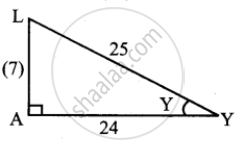
cos y = `- 24/25, pi < y < (3pi)/2`
⇒ Where y is in III quadrant
So, sin y and cos y are –ve
From ΔALY,
AL = `sqrt(25^2 - 24^2)`
= `sqrt(49)`
= 7
∴ cos y = `- 24/25` and sin y = `- 7/25`
sin(x – y) = sin x cos y – cos x sin y
= `(8/17)(- 24/25) - (15/17)(- 7/25)`
= `- 192/425 + 105/425`
= `- 87/425`
APPEARS IN
संबंधित प्रश्न
Find the values of `tan ((19pi)/3)`
Show that `sin^2 pi/18 + sin^2 pi/9 + sin^2 (7pi)/18 + sin^2 (4pi)/9` = 2
If sin x = `15/17` and cos y = `12/13, 0 < x < pi/2, 0 < y < pi/2`, find the value of tan(x + y)
Prove that sin(π + θ) = − sin θ.
Prove that sin 75° – sin 15° = cos 105° + cos 15°
Prove that cos(A + B) cos C – cos(B + C) cos A = sin B sin(C – A)
Show that tan(45° + A) = `(1 + tan"A")/(1 - tan"A")`
Express the following as a sum or difference
2 sin 10θ cos 2θ
Express the following as a sum or difference
cos 5θ cos 2θ
Express the following as a product
sin 75° sin 35°
Show that sin 12° sin 48° sin 54° = `1/8`
Prove that 1 + cos 2x + cos 4x + cos 6x = 4 cos x cos 2x cos 3x
Prove that `sin theta/2 sin (7theta)/2 + sin (3theta)/2 sin (11theta)/2` = sin 2θ sin 5θ
If A + B + C = 180°, prove that cos A + cos B − cos C = `- 1 + 4cos "A"/2 cos "B"/2 sin "C"/2`
If ∆ABC is a right triangle and if ∠A = `pi/2` then prove that sin2 B + sin2 C = 1
Choose the correct alternative:
`1/(cos 80^circ) - sqrt(3)/(sin 80^circ)` =
Choose the correct alternative:
If cos 28° + sin 28° = k3, then cos 17° is equal to
Choose the correct alternative:
`(1 + cos pi/8) (1 + cos (3pi)/8) (1 + cos (5pi)/8) (1 + cos (7pi)/8)` =
Choose the correct alternative:
cos 1° + cos 2° + cos 3° + ... + cos 179° =
