हिंदी

Find One-parameter Families of Solution Curves of the Following Differential Equation:- D Y D X Cos 2 X = Tan X − Y - Mathematics

Advertisements
Advertisements

प्रश्न

Find one-parameter families of solution curves of the following differential equation:-

\[\frac{dy}{dx} \cos^2 x = \tan x - y\]

Solve the following differential equation:-

\[\frac{dy}{dx} \cos^2 x = \tan x - y\]

योग
Advertisements

उत्तर

We have,
\[\frac{dy}{dx} \cos^2 x = \tan x - y\]
\[ \Rightarrow \frac{dy}{dx} + \frac{1}{\cos^2 x}y = \tan x \sec^2 x\]
\[ \Rightarrow \frac{dy}{dx} + y \sec^2 x = \tan x \sec^2 x . . . . . \left( 1 \right)\]
Clearly, it is a linear differential equation of the form
\[\frac{dy}{dx} + Py = Q\]
where
\[P = \sec^2 x\]
\[Q = \tan x \sec^2 x\]
\[ \therefore I.F. = e^{\int P\ dx} \]
\[ = e^{\int \sec^2 x\ dx} \]
\[ = e^{\tan x} \]
\[\text{Multiplying both sides of }\left( 1 \right)\text{ by }e^{\tan x} ,\text{ we get }\]
\[ e^{\tan x} \left( \frac{dy}{dx} + y \sec^2 x \right) = e^{\tan x} \tan x \sec^2 x\]
\[ \Rightarrow e^{\tan x} \frac{dy}{dx} + y e^{\tan x} \sec^2 x = e^{\tan x} \tan x \sec^2 x\]
Integrating both sides with respect to x, we get
\[ e^{\tan x} y = \int e^{\tan x} \tan x \sec^2 x dx + C\]
\[ \Rightarrow e^{\tan x} y = I + C . . . . . . . . . . . \left( 2 \right)\]
Where,
\[I = \int e^{\tan x} \tan x \sec^2 x dx\]
\[\text{Putting }t = \tan x,\text{ we get }\]
\[dt = \sec^2 x dx\]
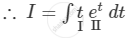
\[ = t\int e^t dt - \int\left[ \frac{d}{dt}\left( t \right)\int e^t dt \right]dt\]
\[ = t e^t - e^t \]
\[ = \left( t - 1 \right) e^t \]
\[ = \left( \tan x - 1 \right) e^{\tan x} \]
\[\text{ Putting the value of I in }\left( 2 \right),\text{ we get }\]
\[ e^{\tan x} y = \left( \tan x - 1 \right) e^{\tan x} + C\]
\[ \Rightarrow y = \left( \tan x - 1 \right) + C e^{- \tan x} \]
\[\text{ Hence, }y = \left( \tan x - 1 \right) + C e^{- \tan x} \text{ is the required solution.}\]

shaalaa.com
  क्या इस प्रश्न या उत्तर में कोई त्रुटि है?
अध्याय 22: Differential Equations - Exercise 22.10 [पृष्ठ १०७]

APPEARS IN

आरडी शर्मा Mathematics [English] Class 12
अध्याय 22 Differential Equations
Exercise 22.10 | Q 36.09 | पृष्ठ १०७

संबंधित प्रश्न

Form the differential equation of the family of ellipses having foci on y-axis and centre at origin.


Form the differential equation of the family of hyperbolas having foci on x-axis and centre at origin.


Form the differential equation of the family of circles having centre on y-axis and radius 3 units.


Which of the following differential equations has y = c1 ex + c2 e–x as the general solution?

(A) `(d^2y)/(dx^2) + y = 0`

(B) `(d^2y)/(dx^2) - y = 0`

(C) `(d^2y)/(dx^2) + 1 = 0`

(D) `(d^2y)/(dx^2)  - 1 = 0`


Form the differential equation of the family of circles in the first quadrant which touch the coordinate axes.


Form the differential equation corresponding to y = emx by eliminating m.


Form the differential equation from the following primitive where constants are arbitrary:
y = cx + 2c2 + c3


Form the differential equation from the following primitive where constants are arbitrary:
xy = a2


Form the differential equation from the following primitive where constants are arbitrary:
y = ax2 + bx + c


Form the differential equation corresponding to (x − a)2 + (y − b)2 = r2 by eliminating a and b.


Form the differential equation of the family of curves represented by the equation (a being the parameter):
(2x − a)2 − y2 = a2


Represent the following families of curves by forming the corresponding differential equations (a, b being parameters):
x2 + (y − b)2 = 1


Represent the following families of curves by forming the corresponding differential equations (a, b being parameters):
y2 = 4a (x − b)


Represent the following families of curves by forming the corresponding differential equations (a, b being parameters):
x2 + y2 = ax3


Form the differential equation of the family of circles in the second quadrant and touching the coordinate axes.


Find one-parameter families of solution curves of the following differential equation:-

\[\frac{dy}{dx} - y = \cos 2x\]


Find one-parameter families of solution curves of the following differential equation:-

\[x\frac{dy}{dx} + y = x^4\]


Find one-parameter families of solution curves of the following differential equation:-

\[\frac{dy}{dx} - \frac{2xy}{1 + x^2} = x^2 + 2\]


Find one-parameter families of solution curves of the following differential equation:-

\[\frac{dy}{dx} + y \cos x = e^{\sin x} \cos x\]


Find one-parameter families of solution curves of the following differential equation:-

\[e^{- y} \sec^2 y dy = dx + x dy\]


Find one-parameter families of solution curves of the following differential equation:-

\[x \log x\frac{dy}{dx} + y = 2 \log x\]


Find one-parameter families of solution curves of the following differential equation:-

\[x\frac{dy}{dx} + 2y = x^2 \log x\]


Write the differential equation representing family of curves y = mx, where m is arbitrary constant.


The differential equation which represents the family of curves y = eCx is


Form the differential equation representing the family of curves y = mx, where m is an arbitrary constant.


Form the differential equation of the family of hyperbolas having foci on x-axis and centre at the origin.


Form the differential equation representing the family of curves y = A sin x, by eliminating the arbitrary constant A.


The differential equation representing the family of curves y = A sinx + B cosx is ______.


Find the equation of a curve passing through origin and satisfying the differential equation `(1 + x^2) "dy"/"dx" + 2xy` = 4x2 


Form the differential equation by eliminating A and B in Ax2 + By2 = 1


Find the equation of a curve passing through (2, 1) if the slope of the tangent to the curve at any point (x, y) is `(x^2 + y^2)/(2xy)`.


Find the equation of a curve passing through the point (1, 1). If the tangent drawn at any point P(x, y) on the curve meets the co-ordinate axes at A and B such that P is the mid-point of AB.


Family y = Ax + A3 of curves is represented by the differential equation of degree ______.


The differential equation `y ("d"y)/("d"x) + "c"` represents: ______.


The differential equation representing the family of circles x2 + (y – a)2 = a2 will be of order two.


The area above the x-axis and under the curve `y = sqrt(1/x - 1)` for `1/2 ≤ x ≤ 1` is:


From the differential equation of the family of circles touching the y-axis at origin


Share
Notifications

Englishहिंदीमराठी


      Forgot password?
Use app×