हिंदी

Find the Coordinates of the Point Where the Line Through the Points (3, - 4, - 5) and (2, - 3, 1), Crosses the Plane Determined by the Points (1, 2, 3), (4, 2,- 3) and (0, 4, 3) - Mathematics

Advertisements
Advertisements

प्रश्न

Find the coordinates of the point where the line through the points (3, - 4, - 5) and (2, - 3, 1), crosses the plane determined by the points (1, 2, 3), (4, 2,- 3) and (0, 4, 3)

Advertisements

उत्तर १

Equation of the line passing through (3, – 4, – 5) and (2, – 3, 1) is
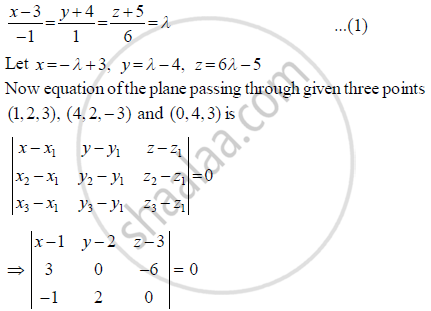
⇒ (x - 1)(12) + (y - 2)6 + (z - 3)6 = 0

12x - 12 + 6y - 12 + 6z -18 = 0

12x + 6y + 6z - 42 = 0

2x + y + z - 7 = 0

2(-λ + 3) + 1(λ - 4) + (6λ - 5) - 7 = 0

- 2λ + 6 + λ - 4 + 6λ - 5 -7 = 0

5λ = 10 ⇒ λ = 2

∴ x = -2 +3, y = 2 - 4, z= 12 - 5

∴ x = 1, y = -2, z = 7

∴ Intersection point is (1,-2,7)

shaalaa.com

उत्तर २

We know that the cartesian equation of a line passing through two points  (x1, y1, z1) 

and (x2, y2, z2)is given by

`(x - x_1)/(x_2 - x_1) = (y - y_1)/(y_2 - y_1) = (z - z_1)/(z_2 -  z_1)`

So, the equation of a line passing through (3, –4, –5) and (2, –3, 1) is

`(x-3)/(2-3) = (y-(-4))/(-3-(-4)) = (z -(-5))/(1-(-5))`

`=> (x - 3)/(-1) = (y - (-4))/1 = (z-(-5))/6`

`=> (x - 3)/(-1) = (y+4)/1 = (z+5)/6`

Now, the coordinates of any point on this line are given by

`(x-3)/(-1) = (y +4)/1 = (z +5)/6 = k`

⇒ x = 3- k,y = k - 4, z = 6k - 5, where k is a constant

Let R(3 − kk − 4, 6k − 5) be the required point of intersection.

Now,
Let the equation of a plane passing through (1, 2, 3) be 

a(x − 1) + b(y − 2) + c(z − 3) = 0                   .....(1)

Here, abc are the direction ratios of the normal to the plane. 

Since the plane (1) passes through (4, 2, −3), so

a(4 - 1) + b(2 - 2) + c(-3 - 3) = 0

⇒ 3a - 6c = 0 .....(2)

Also, the plane (1) passes through (0, 4, 3), so a(0 - 1) + b(4 - 2) + c(3 - 3) = 0

⇒ -a + 2b = 0 .....(3)

Solving (2) and (3) using the method of cross multiplication, we have

`a/(0 + 12) = b/(6 - 0) = c/(6 + 0)`

`=> a/12 = b/6 = c/6`

⇒ `a/2`= b = c = λ (Say)

⇒ a = 2λ, b = λ, c = λ

From (1), we get

2λ(x1λ(y2λ(z3)=0

⇒ 2+7=0                  .....(4)

Putting 3k, k4, 6k5 in (4), we get

⇒ 2(3 - k(k - 4(6k - 5) - 0

5− 10=0

2

Putting k = 2 in R(3 − kk − 4, 6k − 5), we get

R(3 - k, k - 4, 6k - 5R(3 - 2, 2 - 4, × 2 - 5R(1, -2,7)

Thus, the coordinates of the required point are (1, –2, 7) .

shaalaa.com
  क्या इस प्रश्न या उत्तर में कोई त्रुटि है?
2016-2017 (March) All India Set 1

संबंधित प्रश्न

In following cases, determine the direction cosines of the normal to the plane and the distance from the origin.

z = 2


In following cases, determine the direction cosines of the normal to the plane and the distance from the origin.

x + y + z = 1


In following cases, determine the direction cosines of the normal to the plane and the distance from the origin.

2x + 3y – z = 5


Find the equation of the plane with intercept 3 on the y-axis and parallel to ZOX plane.


If the coordinates of the points A, B, C, D be (1, 2, 3), (4, 5, 7), (­−4, 3, −6) and (2, 9, 2) respectively, then find the angle between the lines AB and CD.


Find the coordinates of the point where the line through (5, 1, 6) and (3, 4, 1) crosses the YZ-plane


The planes: 2− y + 4z = 5 and 5x − 2.5y + 10z = 6 are

(A) Perpendicular

(B) Parallel

(C) intersect y-axis

(C) passes through `(0,0,5/4)`


Find the equation of the plane passing through the point (2, 3, 1), given that the direction ratios of the normal to the plane are proportional to 5, 3, 2.


Find the intercepts made on the coordinate axes by the plane 2x + y − 2z = 3 and also find the direction cosines of the normal to the plane.


Reduce the equation 2x − 3y − 6z = 14 to the normal form and, hence, find the length of the perpendicular from the origin to the plane. Also, find the direction cosines of the normal to the plane. 


Reduce the equation \[\vec{r} \cdot \left( \hat{i}  - 2 \hat{j}  + 2 \hat{k}  \right) + 6 = 0\] to normal form and, hence, find the length of the perpendicular from the origin to the plane.


Write the normal form of the equation of the plane 2x − 3y + 6z + 14 = 0.


Find the equation of the plane which contains the line of intersection of the planes \[x + 2y + 3z - 4 = 0 \text { and } 2x + y - z + 5 = 0\] and whose x-intercept is twice its z-intercept.


Prove that the line of section of the planes 5x + 2y − 4z + 2 = 0 and 2x + 8y + 2z − 1 = 0 is parallel to the plane 4x − 2y − 5z − 2 = 0.


Find the equation of the plane passing through the points (−1, 2, 0), (2, 2, −1) and parallel to the line \[\frac{x - 1}{1} = \frac{2y + 1}{2} = \frac{z + 1}{- 1}\]


Find the vector equation of the plane passing through the points (3, 4, 2) and (7, 0, 6) and perpendicular to the plane 2x − 5y − 15 = 0. Also, show that the plane thus obtained contains the line \[\vec{r} = \hat{i} + 3 \hat{j}  - 2 \hat{k}  + \lambda\left( \hat{i}  - \hat{j}  + \hat{k}  \right) .\]


Write the plane  \[\vec{r} \cdot \left( 2 \hat{i}  + 3 \hat{j}  - 6 \hat{k}  \right) = 14\]  in normal form.


The equation of the plane \[\vec{r} = \hat{i} - \hat{j}  + \lambda\left( \hat{i}  + \hat{j} + \hat{k}  \right) + \mu\left( \hat{i}  - 2 \hat{j}  + 3 \hat{k}  \right)\]  in scalar product form is


Find the image of the point having position vector `hat"i" + 3hat"j" + 4hat"k"` in the plane `hat"r" * (2hat"i" - hat"j" + hat"k") + 3` = 0.


The equations of x-axis in space are ______.


Find the equation of a plane which is at a distance `3sqrt(3)` units from origin and the normal to which is equally inclined to coordinate axis.


If the line drawn from the point (–2, – 1, – 3) meets a plane at right angle at the point (1, – 3, 3), find the equation of the plane.


The plane 2x – 3y + 6z – 11 = 0 makes an angle sin–1(α) with x-axis. The value of α is equal to ______.


The unit vector normal to the plane x + 2y +3z – 6 = 0 is `1/sqrt(14)hat"i" + 2/sqrt(14)hat"j" + 3/sqrt(14)hat"k"`.


Find the vector equation of a plane which is at a distance of 7 units from the origin and which is normal to the vector `3hati + 5hatj - 6hatk`


What will be the cartesian equation of the following plane. `vecr * (hati + hatj - hatk)` = 2


Share
Notifications

Englishहिंदीमराठी


      Forgot password?
Use app×