Advertisements
Advertisements
प्रश्न
Find the area enclosed by the curve y = sin x and the X-axis between x = 0 and x = π.
Advertisements
उत्तर
The given equation of the curve is y = sin x.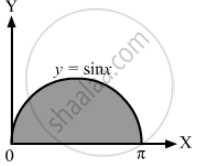
The required area can found by integrating y w.r.t x within the proper limits.
\[\therefore \text{Area} = \int_{x_1}^{x_2} \text{ y }dx = \int_0^\pi \sin \text{ x } dx\]
\[ = \left[ - \cos x \right]_0^\pi \]
\[ = - \cos \pi - \left( - \cos 0 \right)\]
= 1 + 1 = 2 sq. unit
APPEARS IN
संबंधित प्रश्न
Though India now has a large base in science and technology, which is fast expanding, it is still a long way from realizing its potential of becoming a world leader in science. Name some important factors, which in your view have hindered the advancement of science in India.
It is often said that the world is witnessing now a second industrial revolution, which will transform the society as radically as did the first. List some key contemporary areas of science and technology, which are responsible for this revolution.
Write in about 100 words a fiction piece based on your speculation on the science and technology of the twenty-second century.
Science, like any knowledge, can be put to good or bad use, depending on the user.Given below are some of the applications of science. Formulate your views on whether the particular application is good, bad or something that cannot be so clearly categorized :
(a) Mass vaccination against smallpox to curb and finally eradicate this disease from the population. (This has already been successfully done in India.)
(b) Television for the eradication of illiteracy and for mass communication of news and ideas.
(c) Prenatal sex determination.
(d) Computers for the increase in work efficiency.
(e) Putting artificial satellites into orbits around the Earth.
(f) Development of nuclear weapons.
(g) Development of new and powerful techniques of chemical and biological warfare.
(h) Purification of water for drinking.
(i) Plastic surgery.
(j) Cloning.
Though the law gives women equal status in India, many people hold unscientific views on a woman’s innate nature, capacity and intelligence; and in practice give them a secondary status and role. Demolish this view using scientific arguments, and by quoting examples of great women in science and other spheres; and persuade yourself and others that, given equal opportunity, women are on par with men.
The metre is defined as the distance travelled by light in `1/(299,792,458)` second. Why didn't people choose some easier number such as `1/(300,000,000)` second? Why not 1 second?
Suppose you are told that the linear size of everything in the universe has been doubled overnight. Can you test this statement by measuring sizes with a metre stick? Can you test it by using the fact that the speed of light is a universal constant and has not changed? What will happen if all the clocks in the universe also start running at half the speed?
Find the dimensions of electric dipole moment p .
The defining equations are p = q.d and M = IA;
where d is distance, A is area, q is charge and I is current.
Find the dimensions of magnetic dipole moment M.
The defining equations are p = q.d and M = IA;
where d is distance, A is area, q is charge and I is current.
The kinetic energy K of a rotating body depends on its moment of inertia I and its angular speedω. Assuming the relation to be \[k = KI^0w^B\] where k is a dimensionless constant, find a and b. Moment of inertia of a sphere about its diameter is \[\frac{2}{5}M r^2\]
The force on a charged particle due to electric and magnetic fields is given by \[\vec{F} = q \vec{E} + q \vec{\nu} \times \vec{B}\].
Suppose \[\vec{E}\] is along the X-axis and \[\vec{B}\] along the Y-axis. In what direction and with what minimum speed ν should a positively charged particle be sent so that the net force on it is zero?
The electric current in a discharging R−C circuit is given by i = i0 e−t/RC where i0, R and C are constant parameters and t is time. Let i0 = 2⋅00 A, R = 6⋅00 × 105 Ω and C = 0⋅500 μF. (a) Find the current at t = 0⋅3 s. (b) Find the rate of change of current at at 0⋅3 s. (c) Find approximately the current at t = 0⋅31 s.
Find the area bounded by the curve y = e−x, the X-axis and the Y-axis.
A metre scale is graduated at every millimetre. How many significant digits will be there in a length measurement with this scale?
