Advertisements
Advertisements
प्रश्न
Find all the zeroes of polynomial `(2x^4 – 11x^3 + 7x^2 + 13x – 7)`, it being given that two of its zeroes are `(3 + sqrt2) and (3 – sqrt2)`.
Advertisements
उत्तर
The given polynomial is f(x) = `2x^4 – 11x^3 + 7x^2 + 13x – 7.`
Since `(3 + sqrt2) and (3 – sqrt2)` are the zeroes of f(x) it follows that each one of `(x + 3 + sqrt2) and (x + 3 – sqrt2) `is a factor of f(x).
Consequently,` [(x – ( 3 + sqrt2)] [(x – (3 – sqrt2)] = [(x – 3) - sqrt2 ] [(x – 3) + sqrt2 ]`
=`[(x – 3)^2 – 2 ] = x^2 – 6x + 7,` which is a factor of f(x).
On dividing f(x) by `(x^2 – 6x + 7)`, we get:
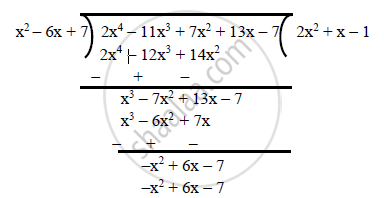
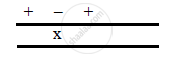
f(x) = 0
⇒` 2x^4 – 11x^3 + 7x^2 + 13x – 7 = 0`
⇒ `(x^2 – 6x + 7) (2x2 + x – 7) = 0`
⇒` (x + 3 + sqrt2) (x + 3 – sqrt2) (2x – 1) (x + 1) = 0`
⇒ `x = –3 – sqrt2 or x = –3 + sqrt2 or x =1/2 or x = -1`
Hence, all the zeroes are `(–3 – sqrt2), (–3 + sqrt2),1/2 and -1.`
APPEARS IN
संबंधित प्रश्न
The graphs of y = p(x) are given in following figure, for some polynomials p(x). Find the number of zeroes of p(x).

Find the zeroes of the polynomial `f(x) = x^2 ˗ 2x ˗ 8` and verify the relation between its zeroes and coefficients
One zero of the polynomial `3x^3+16x^2 +15x-18 is 2/3` . Find the other zeros of the polynomial.
Obtain all other zeroes of `(x^4 + 4x^3 – 2x^2 – 20x – 15)` if two of its zeroes are `sqrt5 and –sqrt5.`
Find the zeroes of the polynomial `x^2 + x – p(p + 1) `
Find the zeroes of the polynomial `x^2 – 3x – m(m + 3)`
Write the zeros of the polynomial `f(x) = x^2 – x – 6`.
If 𝛼 and 𝛽 be the zeroes of the polynomial `2x^2 - 7x + k` write the value of (𝛼 + 𝛽 + 𝛼𝛽).
Find the zeroes of the quadratic polynomial `f(x) = 6x^2 – 3.`
If the zeroes of the polynomial `f(x) = x^3 – 3x^2 + x + 1` are (a – b), a and (a + b), find the values of a and b.
Find the value of k such that the polynomial x2-(k +6)x+ 2(2k - 1) has some of its zeros equal to half of their product.
Find the value of k such that the polynomial x2 − (k + 6)x + 2(2k −1) has sum of its zeros equal to half of their product.
Given that one of the zeroes of the cubic polynomial ax3 + bx2 + cx + d is zero, the product of the other two zeroes is ______.
A quadratic polynomial, whose zeores are -4 and -5, is ______.
Consider the following statements.
- x – 2 is a factor of x3 – 3x² + 4x – 4.
- x + 1 is a factor of 2x3 + 4x + 6.
- x – 1 is a factor of x5 + x4 – x3 + x² -x + 1.
In these statements
The number of polynomials having zeroes as -2 and 5 is ______.
Which of the following is not the graph of a quadratic polynomial?
The number of quadratic polynomials having zeroes –5 and –3 is ______.
The zeroes of the quadratic polynomial 16x2 – 9 are ______.
