हिंदी

The zeroes of the quadratic polynomial x2 + kx + k, k ≠ 0 ______. - Mathematics

Advertisements
Advertisements

प्रश्न

The zeroes of the quadratic polynomial x2 + kx + k, k ≠ 0 ______.

विकल्प

  • Cannot both be positive

  • Cannot both be negative

  • Are always unequal

  • Are always equal

MCQ
रिक्त स्थान भरें
Advertisements

उत्तर

The zeroes of the quadratic polynomial x2 + kx + k, k ≠ 0 cannot both be positive.

Explanation:

Let p(x) = x2 + kx + k, k ≠ 0

On comparing p(x) with ax2 + bx + c, we get

Now, a = 1, b = k and c = k

`x = (-b +- sqrt(b^2 - 4ac))/(2a)`   ....[By quadratic formula]

= `(-k +- sqrt(k^2 - 4k))/(2 xx 1)`

= `(-k +- sqrt(k(k - 4)))/2, k ≠ 0`
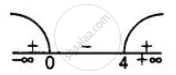
Here, we see that

k(k − 4) > 0

⇒ `k ∈ (-oo, 0)  u  (4, oo)`

Now, we know that

In quadratic polynomial ax2 + bx + c

If a > 0

b > 0

c > 0

or a < 0

b < 0

c < 0

Then the polynomial has always all negative zeroes.

And if a > 0, c < 0 or a < 0, c > 0

Then the polynomial has always zeroes of opposite sign

Case I: If `k ∈ (-oo, 0)`

i.e., k < 0

⇒ a = 1 > 0, b, c = k < 0

So, both zeroes are of opposite sign.

Case II: If `k ∈ (4, oo)`

i.e., k ≥ 4

⇒ a = 1 > 0, b, c > 4

So, both zeroes are negative.

Hence, in any case zeroes of the given quadratic polynomial cannot both be positive.

shaalaa.com
  क्या इस प्रश्न या उत्तर में कोई त्रुटि है?
अध्याय 2: Polynomials - Exercise 2.1 [पृष्ठ १०]

APPEARS IN

एनसीईआरटी एक्झांप्लर Mathematics [English] Class 10
अध्याय 2 Polynomials
Exercise 2.1 | Q 8 | पृष्ठ १०

संबंधित प्रश्न

The graphs of y = p(x) are given in following figure, for some polynomials p(x). Find the number of zeroes of p(x), in the following.


The graphs of y = p(x) are given in following figure, for some polynomials p(x). Find the number of zeroes of p(x).


Find the zeros of the polynomial `f(x) = x^2 + 7x + 12` and verify the relation between its zeroes and coefficients.


Find the zeroes of the quadratic polynomial `f(x) = 5x^2 ˗ 4 ˗ 8x` and verify the relationship between the zeroes and coefficients of the given polynomial.


Find all the zeroes of `(2x^4 – 3x^3 – 5x2 + 9x – 3)`, it is being given that two of its zeroes are `sqrt3 and –sqrt3`. 


Find all the zeroes of polynomial `(2x^4 – 11x^3 + 7x^2 + 13x – 7)`, it being given that two of its zeroes are `(3 + sqrt2) and (3 – sqrt2)`. 


If one zero of the polynomial `x^2-4x+1 is (2+sqrt3)` , write the other zero. 


If one zero of the quadratic polynomial `kx^2 + 3x + k is 2`, then find the value of k.


If -4 is a zero of the polynomial `x^2 – x – (2k + 2) is –4`, then find the value of k. 


If -2 is a zero of the polynomial `3x^2 + 4x + 2k` then find the value of k. 


If 𝛼 and 𝛽 be the zeroes of the polynomial `2x^2 - 7x + k` write the value of (𝛼 + 𝛽 + 𝛼𝛽).


Find the value of k such that the polynomial  x2-(k +6)x+ 2(2k - 1) has some of its zeros equal to half of their product.


Find the value of k such that the polynomial x2 − (k + 6)x + 2(2k −1) has sum of its zeros equal to half of their product.


If the zeroes of the quadratic polynomial ax² + bx + c, c # 0 are equal, then ______.


The zeroes of the quadratic polynomial x² + 1750x + 175000 are ______.


A polynomial of degree n has ______.


If f(x) = 5x - 10 is divided by x – `sqrt2`, then the remainder will be ______.


If the graph of a polynomial intersects the x-axis at only one point, it cannot be a quadratic polynomial.


If the graph of a polynomial intersects the x-axis at exactly two points, it need not be a quadratic polynomial.


If the zeroes of the quadratic polynomial ax2 + bx + c, c ≠ 0 are equal, then ______.


Share
Notifications

Englishहिंदीमराठी


      Forgot password?
Use app×