Advertisements
Advertisements
प्रश्न
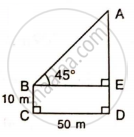
Find AD, if :
Advertisements
उत्तर
From the right triangle ABE
tan 45° = `("AE")/("BE")`
1 = `("AE")/("BE")`
AE = BE
Therefore AE = BE = 50 m.
Now from the rectangle BCDE we have
DE = BC = 10 m.
Therefore the length of AD will be:
AD = AE + DE = 50 + 10 = 60 m.
APPEARS IN
संबंधित प्रश्न
Find angle 'A' if :
Use the information given to find the length of AB.

In the given figure, AB and EC are parallel to each other. Sides AD and BC are 2 cm each and are perpendicular to AB.

Given that ∠ AED = 60° and ∠ ACD = 45°. Calculate: AB.
In the given figure, AB and EC are parallel to each other. Sides AD and BC are 2 cm each and are perpendicular to AB.

Given that ∠ AED = 60° and ∠ ACD = 45°. Calculate: AE.
In right-angled triangle ABC; ∠ B = 90°. Find the magnitude of angle A, if: AB is √3 times of BC.
In right-angled triangle ABC; ∠B = 90°. Find the magnitude of angle A, if:
BC is `sqrt(3)` times of AB.
A ladder is placed against a vertical tower. If the ladder makes an angle of 30° with the ground and reaches upto a height of 15 m of the tower; find length of the ladder.
Find AB and BC, if:

Find AB and BC, if:

The perimeter of a rhombus is 96 cm and obtuse angle of it is 120°. Find the lengths of its diagonals.
