Advertisements
Advertisements
प्रश्न
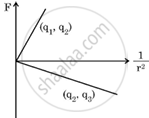
Figure shows variation of Coulomb force (F) acting between two point charges with `1/r^2`, r being the separation between the two charges (q1, q2) and (q2, q3). If q2 is positive and least in magnitude, then the magnitudes of q1, q2 and q3 are such that:
विकल्प
q2 < q3 < q1
q3 < q1 < q2
q1 < q2 < q3
q2 < q1 < q3
MCQ
Advertisements
उत्तर
q2 < q3 < q1
Explanation:
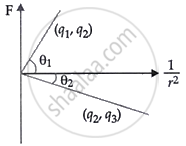
Given q2 is positive and least in magnitude.
From Coulomb’s Force, (F) = `1/(4 pi epsilon_0) (q_1q_2)/r^2`
Now, from the given graph F vs `1/r^2`, the product of the magnitude of the charges will be the slope of the curve.
∵ tan θ1 > tan θ2
⇒ θ1 > θ2 ...[If the angle is very small.]
⇒ q1q2 > q2q3
⇒ q1 > q3
And q2 has the least magnitude.
Hence, q1 > q3 > q2
shaalaa.com
क्या इस प्रश्न या उत्तर में कोई त्रुटि है?
