Advertisements
Advertisements
प्रश्न
f(x) = 4x3 − 12x2 + 14x − 3, g(x) 2x − 1
Advertisements
उत्तर
Let us denote the given polynomials as
`f(x) = 4x^2 - 12x^3 - 12x^2 + 14x - 3,`
`g(x) = 2x - 1`
`⇒ g (x) = 2 (x - 1/2)`
We have to find the remainder when f(x) is divided by g(x).
By the remainder theorem, when f(x) is divided by g(x) the remainder is
`f(1/2) = 4(1/2)^3 - 12(1/2)^2 + 14 (1/2) - 3`
` = 4 xx 1/8 - 12 xx 1/4 + 14 xx 1/2 - 3`
` = 1/2 -3 + 7 - 3`
`= 3/2`
Now we will calculate the remainder by actual division
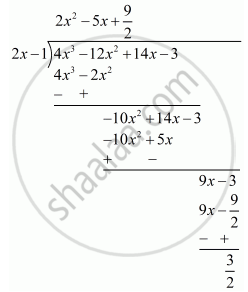
So the remainder by actual division is `3/2` .
APPEARS IN
संबंधित प्रश्न
Identify polynomials in the following:
`p(x)=2/3x^3-7/4x+9`
Find rational roots of the polynomial f(x) = 2x3 + x2 − 7x − 6.
Show that (x − 2), (x + 3) and (x − 4) are factors of x3 − 3x2 − 10x + 24.
If x3 + ax2 − bx+ 10 is divisible by x2 − 3x + 2, find the values of a and b.
x3 + 13x2 + 32x + 20
Write the remainder when the polynomialf(x) = x3 + x2 − 3x + 2 is divided by x + 1.
(x+1) is a factor of xn + 1 only if
If both x − 2 and \[x - \frac{1}{2}\] are factors of px2 + 5x + r, then
Factorise the following:
5x2 – 29xy – 42y2
Factorise the following:
8m3 – 2m2n – 15mn2
