Advertisements
Advertisements
प्रश्न
Explain with an example, the propagation of sound in a medium.
Advertisements
उत्तर
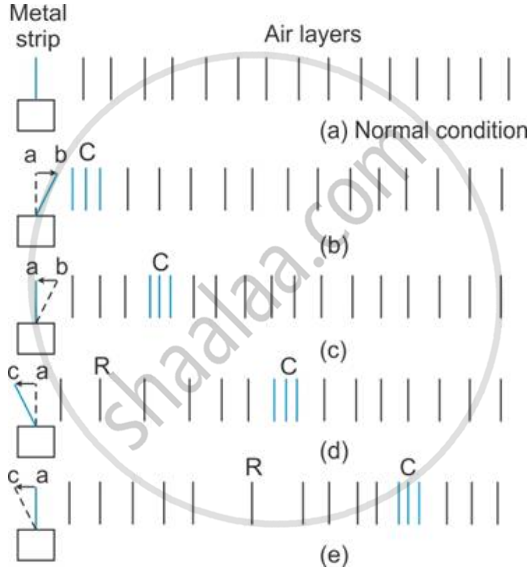
Take a vertical metal strip with its lower end fixed and upper end being free to vibrate as shown in fig (a).
As the strip is moved to right from a to b as shown in Fig (b), the air in that layer is compressed (compression is formed at C). The particles of this layer compress the layer next to it, which then compresses the next layer and so on. Thus, the disturbance moves forward in form of compression without the particles themselves being displaced from their mean positions.
As the metal strip returns from b to a as shown in Fig (c) after pushing the particles in front, the compression C moves forward and particles of air near the strip return to their normal positions.
When the strip moves from a to c as shown in Fig (d), it pushes back the layer of air near it towards left and thus produces a low pressure space on its right side i.e. layers of air get rarefied. This region is called rarefaction (rarefaction is formed at R).
When the strip returns from C to its mean position A in Fig (e), the rarefaction R travels forward and air near the strip return to their normal positions.
Thus, one complete to and fro motion of the strip forms one compression and one rarefaction, which together form one wave. This wave through which sound travels in air is called longitudinal wave.
APPEARS IN
संबंधित प्रश्न
Describe a simple experiment which demonstrates that the sound produced by a tuning fork is due to vibrations of its arms.
Explain the terms crest and trough in relation to a transverse wave.
How does the following factor affect, if at all, the speed of sound in air:
Temperature of air
A longitudinal wave travels at a speed of 0.3 m s-1 and the frequency of wave is 20 Hz. Find the separation between two consecutive compressions.
Select the correct option:
The SI unit of frequency is
Why do astronauts talk to each other through radio telephone in space?
Define the term wavelength.
State four differences between the sound wave and the light wave.
Does sound require a material medium for transmission?
Compare approximately the speed of sound in air and steel.
