Advertisements
Advertisements
प्रश्न
Explain, why radium paint, consisting of zinc sulphide and a trace of radium salt, glows in the dark?
Advertisements
उत्तर
Radium is a radioactive substance. It gives out radioactive radiations which show fluorescence in zinc sulphide. Zinc sulphide is a fluorescent material, so it glows in dark.
संबंधित प्रश्न
Name the radiations which are absorbed by greenhouse gases in the earth’s atmosphere.
Answer the following questions based on a hot cathode ray tube.
What will happen to the beam when it passes through the electric field?
Name a gas caused by the Greenhouse effect
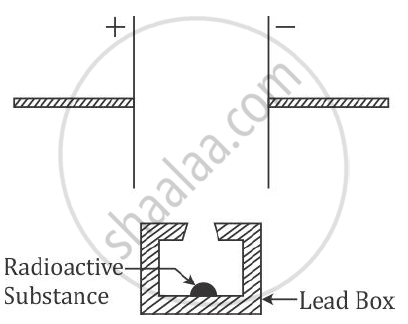
Complete the diagram as given above by drawing the deflection of radioactive radiations in an electric field
A nucleus `""_11^24Na` emits a beta particle to change into Magnesium (Mg)
(i) Write the symbolic equation for the process.
(ii) What are numbers 24 and 11 called?
(iii) What is the general name of `""_12^24Mg `with respect to `""_11^24Na` ?
Give one example of isobars.
A nucleus is \[\ce{^24_11 Na}\] β-radioactive.
Write the equation represent β-decay.
During the emission of a beta particle, the ______ number remains same.
What are cathode rays? Why are they called ‘cathode rays’? Name a material which exhibits fluorescence when cathode rays fall on it.
State three ways of obtaining an electron-beam.
